

Your lease has two years left. The carpet at reception has worn through. The meeting rooms are booked solid by Tuesday, and from April to September the AC gives up every afternoon. Your finance head wants a straight answer: fix this floor, or find another one?
The usual assumption is that renovating is far cheaper than moving. On published Delhi numbers it is cheaper, but by less than you’d expect on construction, and cost is not what decides it. On a 10,000 sq ft floor the averages put the premium for moving near ₹1.7 crore, and nearly half of that is the bill for the floor you leave.
The short answer
Renovate when the problem sits inside your walls: layout, finishes, lighting, meeting rooms, the mix of desks. That only holds if the building can still supply the power and cooling you need and you can stay long enough to earn the money back. Relocate when the problem is the building itself or the size of the floor, or when your lock-in is nearly over anyway.
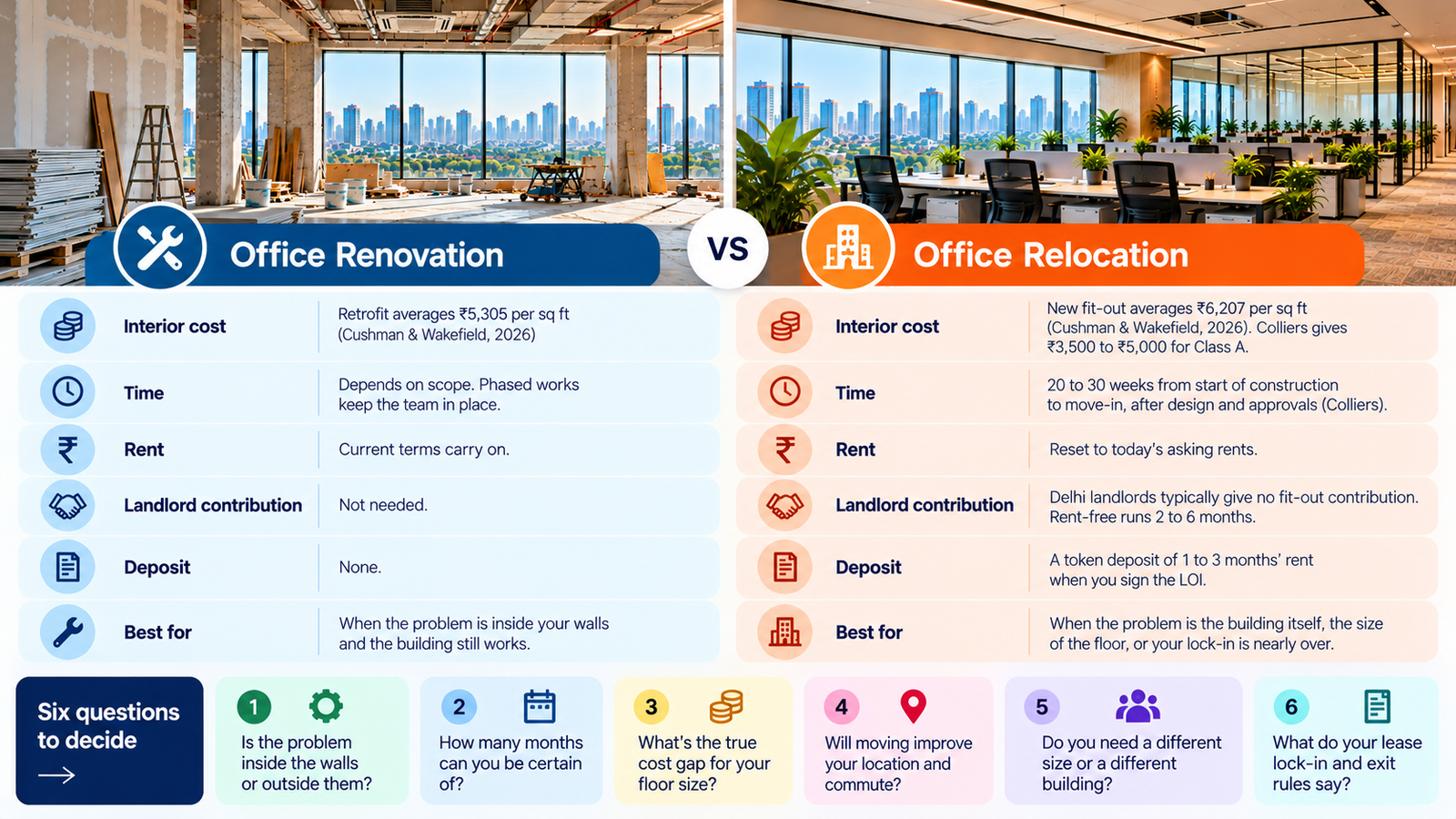
Cost rarely settles it. Cushman & Wakefield’s 2026 fit-out guide puts the average retrofit of a Delhi floor at ₹5,305 per sq ft, against ₹6,207 for a new fit-out, about 85%. The rest of the gap between staying and leaving is rent, time and what you owe on the floor you leave.
What each route costs, on published Delhi numbers
Two sources do the work here, and both publish Delhi figures, the closest published benchmarks for Gurgaon and Noida. Colliers’ Global Occupier Guide for Delhi covers lease practice and build times, and gives a Class A fit-out range. Cushman & Wakefield (C&W) prices a new fit-out, a retrofit (refitting a floor that already has a fit-out) and a reinstatement (returning a floor to the condition your lease demands when you leave) as separate lines, which is the split this decision needs. Both are benchmarks, not quotes. C&W says as much, and its figures reflect December 2025.
| Cost line | Renovate in place | Relocate |
|---|---|---|
| Building the interior | Retrofit averages ₹5,305 per sq ft (US$59) | New fit-out averages ₹6,207 per sq ft (US$69). Colliers gives ₹3,500 to ₹5,000 for Class A |
| The floor you leave | Deferred until you eventually exit | Reinstatement averages ₹807 per sq ft (US$9), if your lease requires it |
| Time | Depends on scope. Phased works keep the team in place | 20 to 30 weeks from start of construction to move-in, after design and approvals |
| Rent | Current terms carry on | Reset to today’s asking rents |
| Landlord money | Not needed | Delhi landlords typically give no fit-out contribution. Rent-free runs 2 to 6 months |
| Deposit | None | A token deposit of 1 to 3 months’ rent when you sign the LOI |
The two guides don’t define a floor the same way, so treat the fit-out figures as brackets around your own quote, not substitutes for it.
Run the averages on 10,000 sq ft. A retrofit comes to ₹5.3 crore and a new fit-out to ₹6.2 crore, about ₹90 lakh more. Add reinstatement on the floor you’re leaving, roughly ₹81 lakh, and moving costs about ₹1.7 crore more than renovating, and that is before a day of overlapping rent or anyone carrying a desk down the stairs. Treat it as a marker, not a quote. Reinstatement counts only if your lease demands it, and your floor will move every line.
Renovating does come out cheaper. But at 85% of a new fit-out, a deep renovation is a serious spend and not a touch-up, and it only pays back if you stay long enough to use it. Nearly half of the moving premium is the reinstatement bill on the floor you leave. Renovation wins on the other lines too: you don’t pay double rent, you lose far less time, and you skip the deposit and the repricing.
Start with the lease, not the layout
Colliers puts typical office lease terms in Delhi at 5 to 9 years, with the tenant locked in for 50 to 60% of the term. Leave inside the lock-in and you pay the rent for what remains of it. On a nine-year lease that is 4.5 to 5.4 years you can’t walk away from cheaply. On a five-year lease, 2.5 to 3.
The first question, then, is how many months you can count on, not whether the floor looks tired. Spread the retrofit average of ₹5,305 per sq ft over a floor with two years left and it comes to about ₹221 per sq ft per month, more than the monthly rent in any Gurgaon or Noida micro-market in C&W’s Q3 2026 report, Cyber City’s ₹150 included. You’d be paying off the refit faster than you pay for the space. Spread the same spend over a five-year renewal and it falls to about ₹88. The retrofit hasn’t changed. The tenure has.
If the runway is short, renew first and renovate second. Tenants can sometimes negotiate a “blend and extend”, an early renewal on revised terms, when the market allows it, according to Colliers. Ask for one before you spend anything on the floor. Failing that, refresh only reception and the meeting rooms, or move.
What moving does to your rent
C&W’s Delhi NCR office report for Q3 2026 shows where Grade A rents stood at the end of September.
| Micro-market | Asking rent (₹ per sq ft per month) | Vacancy |
|---|---|---|
| Delhi CBD | 300 | 18.6% |
| Aerocity (Delhi International Airport) | 244 | 28.7% |
| Cyber City | 150 | 1.3% |
| Golf Course Road | 137 | 5.1% |
| MG Road | 131 | 5.0% |
| South-East Delhi | 126 | 14.2% |
| NH-8 Prime | 121 | 7.3% |
| Gurugram Others (includes Sohna Road, Golf Course Extension Road, Udyog Vihar) | 68 | 26.8% |
| Noida | 62 | 19.8% |
| Delhi NCR overall | 96 | 17.6% |
These are stock-weighted asking rents for Grade A space with high-side air conditioning and full power backup. What you’d actually pay depends on the building.
Rents across the region rose 6 to 9% year on year, and 12 to 15% in Gurgaon CBD and NH-8 Prime. If your rent was set a few years ago, a move reprices you to numbers like these.
Where you sit changes how that plays out. In Cyber City, with 1.3% vacancy, there’s almost nothing to move to, so staying and renovating is often the only practical option. In the “Gurugram Others” bucket, which takes in Udyog Vihar and Sohna Road among others, more than a quarter of Grade A space is empty. Landlords there have reason to keep you, so ask for more than a repaint when the renewal comes up. That last point is our reading of the vacancy data, not something C&W says.
Six questions that settle it
Take them in order. If the first comes back “outside”, you can often stop there.
Is the problem inside the walls or outside them?
Cramped meeting rooms, dead acoustics, tired finishes, a layout built for a team that no longer exists: all fixable in place. A commute your people hate, an address clients don’t take seriously, a floor plate the wrong shape: no amount of paint touches any of that.
How many months can you be certain of?
Count the lock-in and any renewal right, then whatever your landlord will put in writing. Under two years, we wouldn’t spend retrofit money.
Has headcount changed enough to need a different floor?
Renovation can fit more desks onto a floor but it can’t add area. If you’ve outgrown the space, work out how much you need before you decide anything else. Where hybrid working has left desks empty, reconfigure instead of relocating. Colliers notes that desk-sharing is common in the Delhi market, and a floor planned around it needs fewer workstations and more rooms for meetings, not a bigger lease.
Can the building carry what you want to add?
More people means more heat and more load. Summers here run to 40 to 45°C, and an AC plant sized for the headcount you had won’t love the headcount you’re planning. Check cooling capacity and DG backup before you draw a layout. A building that can’t supply them has an outside-the-walls problem, and it points to a move.
What is the market doing around you?
Go back to the rent table. Low vacancy means few alternatives and a landlord who knows it. High vacancy means options, and bargaining power.
What happens at the other end?
Read the handover clause in your lease now, not in the month you leave. If it demands restoration to shell, put roughly ₹807 per sq ft on the relocation side of the sum. Where it’s silent, Colliers says reinstatement in Delhi applies only where it was agreed in the original lease.
A middle path: renovate in phases, build in what can move
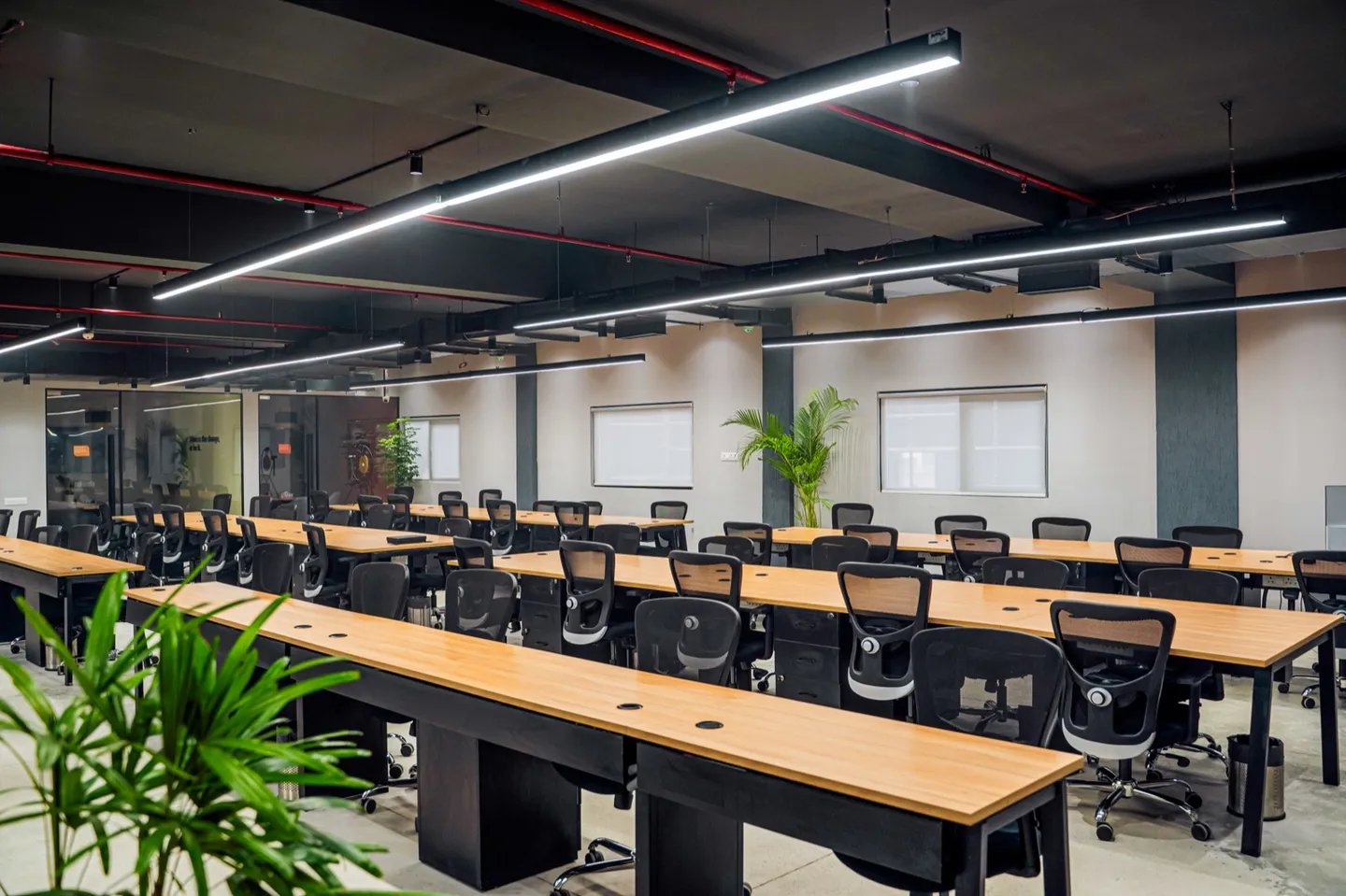
Staying doesn’t have to mean a big-bang refit. Phase the work zone by zone while the team stays in and you never pay double rent or lose a week to moving. Spend where people judge you, which is reception and the meeting rooms, and specify partitions and furniture that can be reconfigured later (flexible and modular office design), so the next change in headcount is a small job and not a project.
If you do renovate, brief it as its own discipline. Working around a live team, with its noise and its fire-exit rules, is a different job from fitting out an empty shell, and the scope for an office renovation should say how the floor stays usable while the work happens.
What we’d do
Pull the lease and find the lock-in date and the handover clause. Get two itemised quotes priced against the same scope list, one for the renovation you’d really do and one for the bespoke office interior design of the floor you’d move to, because a renovation quote that quietly leaves out the ceiling or the AC work looks cheap until it doesn’t. Add the extra lines from the table. Then ask the question that outranks the arithmetic: is the problem inside the walls?
If it is, renovate and stop shopping for floors. If it isn’t, no refit will fix it, and the lock-in date tells you how long you have to find one that does.
Weighing renovation against a move for a Delhi NCR floor? Talk to Orange Offices. Bring your lease and a rough scope, and we’ll tell you what a renovation would involve and how it compares with the move.