A finance director in Udyog Vihar asked us to review three fit-out quotes before their team made a decision. The range: ₹87 lakh, ₹1.2 crore, and ₹1.65 crore. Same brief. Same 5,000 sq ft floor. Same building.
The cheapest quote excluded demolition of the existing false ceiling, MEP rough-in work, and the building management NOC costs. The most expensive had an 18% project management fee built in with no breakdown of what was being managed. The middle quote was the most honest – but it still didn’t include furniture, AV, or design fees. Those three items together added ₹55 lakh to the actual project cost.
None of them were lying. They were quoting different things.
That’s the core problem with office fit-out budgeting in Delhi NCR. There’s no standard definition of what a ‘fit-out quote’ includes, so clients compare numbers that aren’t comparable, choose one, and discover the shortfall mid-project when it’s too late to do much about it. This guide breaks down what the actual cost of a Delhi NCR office fit-out looks like, where the variation comes from, and what the total typically adds up to once all the separate line items are on the same page.
Why quotes for the same office can differ by 90%
The main reason is scope. A contractor quoting on a basic second-generation fit-out (standard materials, existing MEP infrastructure, minimal custom work) and a contractor quoting on a premium first-generation shell fit-out (bare slab, full MEP installation, bespoke joinery throughout) are doing genuinely different amounts of work. The ₹/sq ft figure means almost nothing without knowing what it includes.
Beyond scope, there are structural differences in how Delhi NCR contractors build quotes. Some price materials at cost and add a transparent margin. Others bundle margin into labour rates and quote labour at inflated figures. Some include a project management fee as a separate line; others fold it into overheads and don’t mention it. Some include a contingency in their quote; others rely on variation orders during construction to cover anything that wasn’t anticipated.
The construction market is also tiered. CBRE India’s office market research identifies significant cost variation between branded turnkey fit-out firms, mid-tier local contractors, and smaller sub-contractors – a range that reflects genuine differences in quality control, accountability, and what happens when something goes wrong on site. A low quote from an unknown contractor is a different risk profile from the same quote from a firm with a project track record.
The safest approach is to request itemised quotes that break down civil work, MEP, flooring, ceiling, partitions, and finishes separately. Itemised quotes are harder to compare at a glance, but they’re the only format that makes scope differences visible.
Construction costs: what the building work actually costs
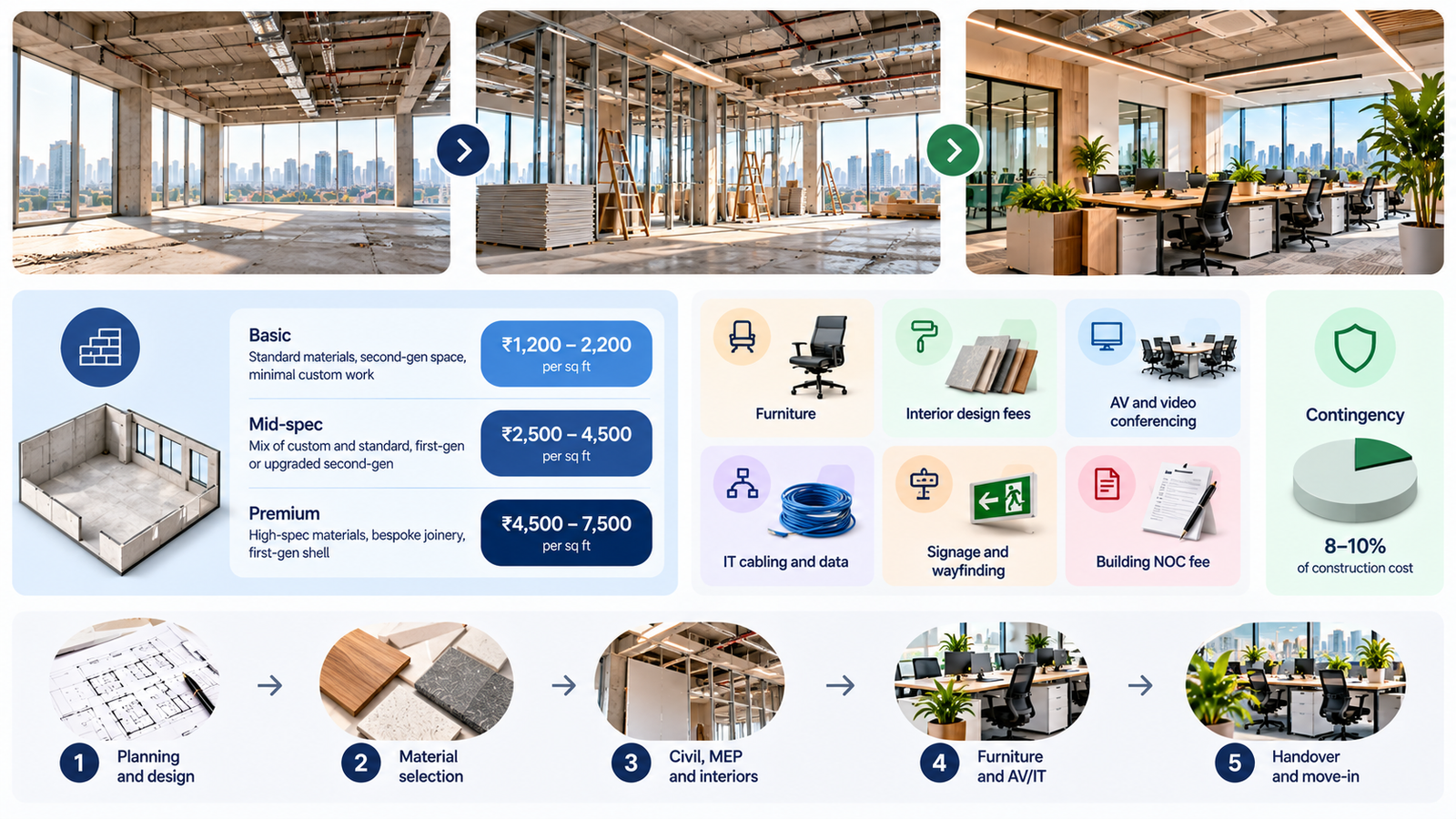
The figures below cover the core fit-out construction: civil work, partitions, ceiling, flooring, MEP connections, electrical, painting, and basic finishes. They’re based on rates for Delhi NCR commercial projects and reflect the installed cost (materials plus labour). They do not include furniture, AV/IT, design fees, or the separately-quoted items covered later in this article.
| Spec level | Typical scope | ₹/sq ft (construction only) |
|---|---|---|
| Basic | Standard materials, second-gen space, minimal custom work | ₹1,200–2,200 |
| Mid-spec | Mix of custom and standard, first-gen or upgraded second-gen | ₹2,500–4,500 |
| Premium | High-spec materials, bespoke joinery, first-gen shell | ₹4,500–7,500 |
The ‘basic’ range is a realistic budget for a second-generation space with standard floor tiles or carpet, a suspended grid ceiling, drywall partitions, and standard electrical distribution. The mid-spec range introduces some custom millwork, better materials (vinyl flooring rather than standard tiles, acoustic ceiling panels, glass partitions rather than solid drywall), and typically a first-generation shell requiring full MEP installation. The premium range covers high-spec materials, bespoke joinery, acoustic treatment, feature ceilings, and imported finishes.
For context, JLL India’s workplace design research shows that GCC fit-outs in Gurgaon – which tend to sit at the mid-to-premium end of the specification range – have been averaging ₹3,500–5,500/sq ft for construction over the past two years, consistent with the mid-spec and lower premium ranges above.
Design fees: what you pay the interior designer
Interior design fees are charged separately from construction costs and are typically one of the first costs a client encounters. They generally take one of two forms.
Fee-per-square-foot pricing runs ₹80–150/sq ft for a full design service: space planning, concept development, material specifications, working drawings, contractor tender management, and site supervision during construction. For a 5,000 sq ft office, that’s ₹4–7.5 lakh for the design component alone.
Percentage-of-project-value pricing ties the design fee to the total construction cost, typically 8–12%. This aligns the designer’s fee with the complexity and value of the project. It can be more appropriate for larger or more complex projects where the scope of design work scales with the build.
A few things to watch for. Design fees that seem unusually low (under ₹60/sq ft or under 6% of project value) often reflect a reduced service: concept only, no working drawings, no site supervision. The contractor then takes over specification decisions that should have been made by the designer, and quality suffers. The cheapest design option is rarely the cheapest project.
Furniture: the biggest variable in the budget
Furniture is almost always quoted and procured separately from construction. In a typical fit-out budget, it’s the second-largest line item after construction – and the one with the widest range.
What drives the range
At the budget end, Indian-manufactured workstations from Godrej, Featherlite, or Durian start at ₹500–1,000/sq ft. These are functional, widely available, and have reasonable lead times. The quality is adequate for a basic office environment and the serviceability is good because spares and replacement parts are easy to source locally.
Mid-range furniture from Haworth India, Wipro Furniture, or premium local brands runs ₹1,000–2,000/sq ft. This range typically offers better ergonomics, more configuration options, and higher build quality. For an office that’s doing any kind of impression work – client meetings, hiring, senior leadership – mid-range is usually the right starting point.
Premium imported furniture from Herman Miller, Steelcase, or Knoll – companies whose workplace research on ergonomics and collaboration has shaped office design thinking globally – starts at ₹2,500/sq ft and goes considerably higher. The lead times for imported furniture typically run 10–16 weeks, and the price premium over Indian-manufactured equivalents can be 150–300%. The ergonomic and durability case for premium brands is real, but the cost case is harder to make unless the organisation genuinely values it or is designing a GCC space where a recognised brand carries weight with global leadership.
One common mistake: deciding on furniture specification late in the project. Premium or imported furniture needs to be ordered during or before the construction phase to arrive on time. Leaving it until the fit-out is almost complete and then discovering that the specification the client wants has a 14-week lead time creates a gap between construction completion and move-in that nobody budgeted for.
AV and IT infrastructure
AV and IT infrastructure is the item that causes the most budget surprises in otherwise well-planned fit-outs. It’s almost always excluded from the main contractor quote and handled by a specialist sub-contractor.
The range is wide. A basic AV setup – wall-mounted screens in meeting rooms, a simple speakerphone in each room, and standard structured cabling throughout the office – might run ₹100–200/sq ft. A full video conferencing setup with ceiling microphone arrays, 4K displays, room booking panels, and integration into a unified communications platform runs ₹300–600/sq ft. GCC offices with presentation technology, broadcast-quality AV in town halls, and smart building integration have gone above ₹1,000/sq ft for this line item alone.
IT cabling (structured cabling for data and power) is a separate sub-item within the AV and IT budget. It typically runs ₹80–200/sq ft depending on cable density and the quality of the installation. This has to be planned and installed before the ceiling goes up, so the coordination sequence with the main contractor matters. AV consultants or IT infrastructure teams are often brought in after the fit-out design is finalised, which is too late to properly coordinate with the construction sequence. The right time to involve the AV/IT team is at the design development stage.
What’s commonly missing from fit-out budgets
The table below covers the items that are consistently absent from initial budget calculations – either because they’re genuinely separate line items or because they’re not visible until the project is underway.
| Item | Typical budget range | Notes |
|---|---|---|
| Interior design fees | ₹80–150/sq ft or 8–12% of project value | Varies by firm scope and project size |
| Furniture (local/budget) | ₹500–1,000/sq ft | Godrej, Featherlite, local vendors |
| Furniture (mid-range) | ₹1,000–2,000/sq ft | Haworth India, Wipro Furniture |
| Furniture (premium imported) | ₹2,500–5,000/sq ft | Herman Miller, Steelcase, Knoll |
| AV and video conferencing | ₹100–600/sq ft | Highly variable by meeting room count |
| IT cabling and data | ₹80–200/sq ft | Separate from AV |
| Signage and wayfinding | ₹1–5 lakh (one-off) | Brand-dependent |
| Building NOC fee | ₹25,000–1,00,000 | Building-dependent |
| Contingency | 8–10% of construction cost | Non-negotiable |
The contingency line deserves its own mention. An 8–10% contingency on construction costs is standard practice in any construction project. It’s not pessimism. In Delhi NCR office fit-outs specifically, it covers the cost of variations during the building management NOC process (where the building may require changes to the approved design), unforeseen conditions in the existing slab or MEP infrastructure, and scope additions that arise once construction starts and the client sees the space taking shape. Fit-outs that enter construction without a contingency either stop for budget approvals mid-project or end up with compromised finishes to recover the cost.
What drives costs up – and what actually keeps them down
First-generation vs second-generation space. A bare shell (first-gen) requires full MEP installation from the building riser – electrical distribution, HVAC ducting, plumbing if there’s a pantry. A previously-fitted-out space (second-gen) has this infrastructure already in place. The saving on MEP alone can be ₹400–800/sq ft. Second-gen spaces are generally cheaper to fit out, faster to deliver, and carry less risk of infrastructure surprises.
Custom millwork and joinery. Reception desks, bespoke storage walls, custom workstation systems, and branded feature elements are the single biggest driver of cost variation between mid-spec and premium projects. A reception desk can be ₹2–5 lakh for a standard manufactured unit or ₹10–25 lakh for a bespoke design in premium materials. That’s not a specification difference – it’s a design decision that needs to be made consciously.
Material imports. Italian stone, European timber veneers, imported acoustic panels, and overseas lighting fixtures all attract import duties and have longer lead times. They add cost and complexity. The alternative – high-quality Indian-manufactured equivalents in stone, wood, and acoustic materials – has improved significantly and now covers most specification requirements at 30–50% less than the imported equivalent.
Brief changes after construction starts. Every significant change to the scope after construction begins costs more than it would have cost in the design stage. A wall moved during construction costs the demolition of what’s already built, the relocation of any MEP that runs through it, and the rebuild. Changes to the brief once on site are the most reliable way to overspend a fit-out budget.
What actually keeps costs down: a clear brief agreed before design begins, a defined and fixed specification before tendering, a contractor selected on scope rather than headline number, and a properly sized contingency that doesn’t need to be raided for normal project variation.
Getting to a realistic total
For a 5,000 sq ft mid-specification office in a Gurgaon commercial building, a realistic total budget looks something like this:
- • Construction (mid-spec, first-gen shell): ₹1.25–2.25 crore (₹2,500–4,500/sq ft)
- • Interior design fees: ₹40–75 lakh (₹80–150/sq ft)
- • Furniture (mid-range): ₹50 lakh–1 crore (₹1,000–2,000/sq ft)
- • AV and IT infrastructure: ₹15–30 lakh (₹300–600/sq ft)
- • Contingency at 10%: ₹12–22 lakh (on construction cost)
- • Signage, building NOC fees, ancillaries: ₹3–8 lakh
Total realistic range: ₹2.5–4.5 crore for a 5,000 sq ft mid-specification office, first-gen shell.
For a second-gen space with similar specification, subtract ₹20–40 lakh from the construction line (no full MEP installation required). For a basic specification in a second-gen space, the total can come down to ₹1.2–1.8 crore.
For a premium specification first-gen fit-out with imported materials and premium furniture, the total can reach ₹6–10 crore or above for the same 5,000 sq ft – which is why specification level is the most important decision in any fit-out budget conversation, and the one that should happen before any contractor is approached.
Planning a Delhi NCR office fit-out and want a realistic budget before the contractor quotes come in? Talk to Orange Offices – we can help you build an accurate total budget picture, including the items that are most often missed.