
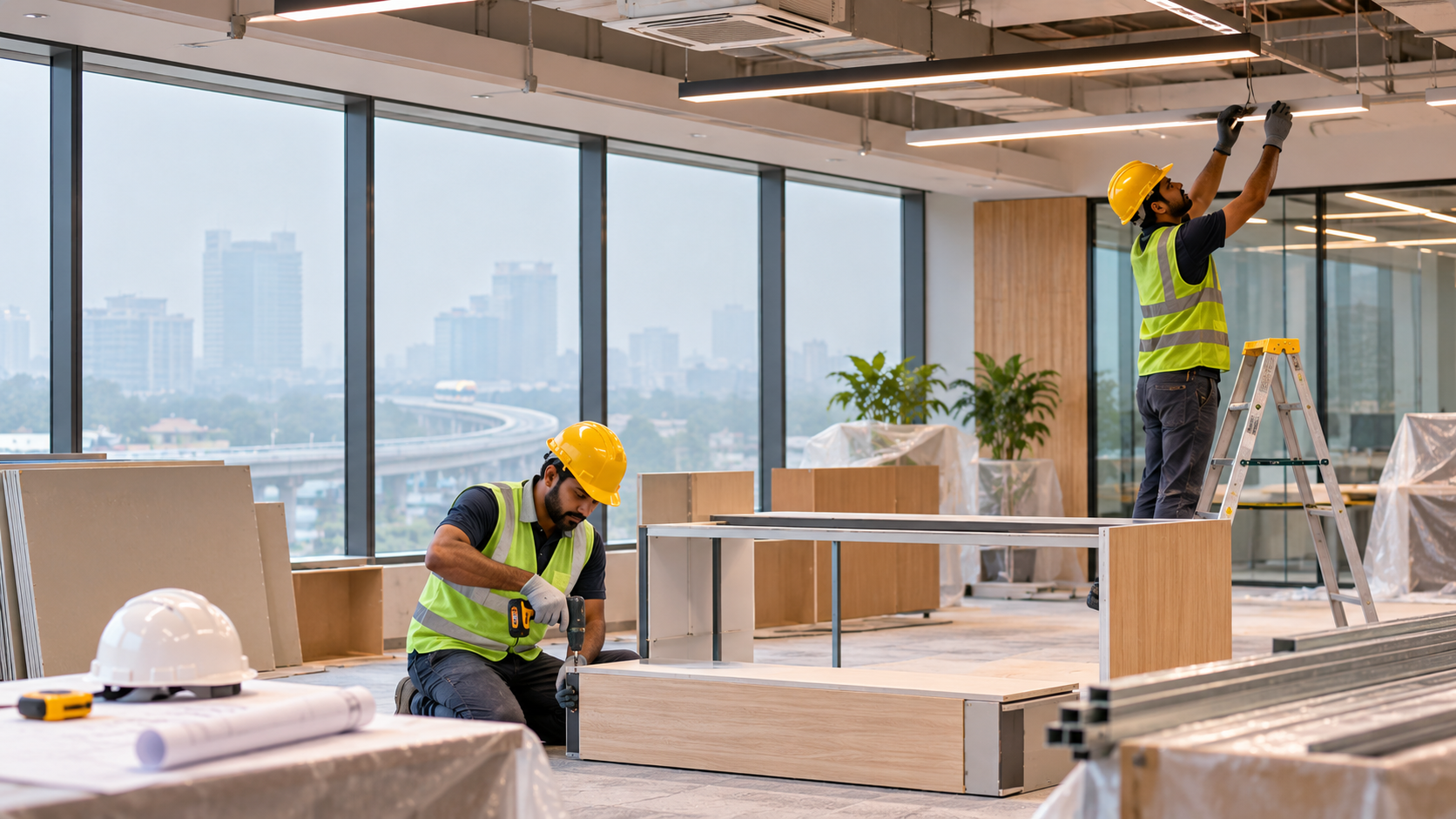
You’ve taken a floor with the last tenant’s fit-out still in it, and your contractor’s programme opens with strip-out. Strip-out is demolition. Demolition is the first thing this winter’s fixed restrictions name.
Much of an office fit-out can carry on through a Delhi NCR winter. The part that can’t is the part that makes dust, and strip-out is where a second-generation fit-out begins. This guide covers which rules are in force, what each one stops, and how to plan a programme that bends instead of breaking.
The short answer
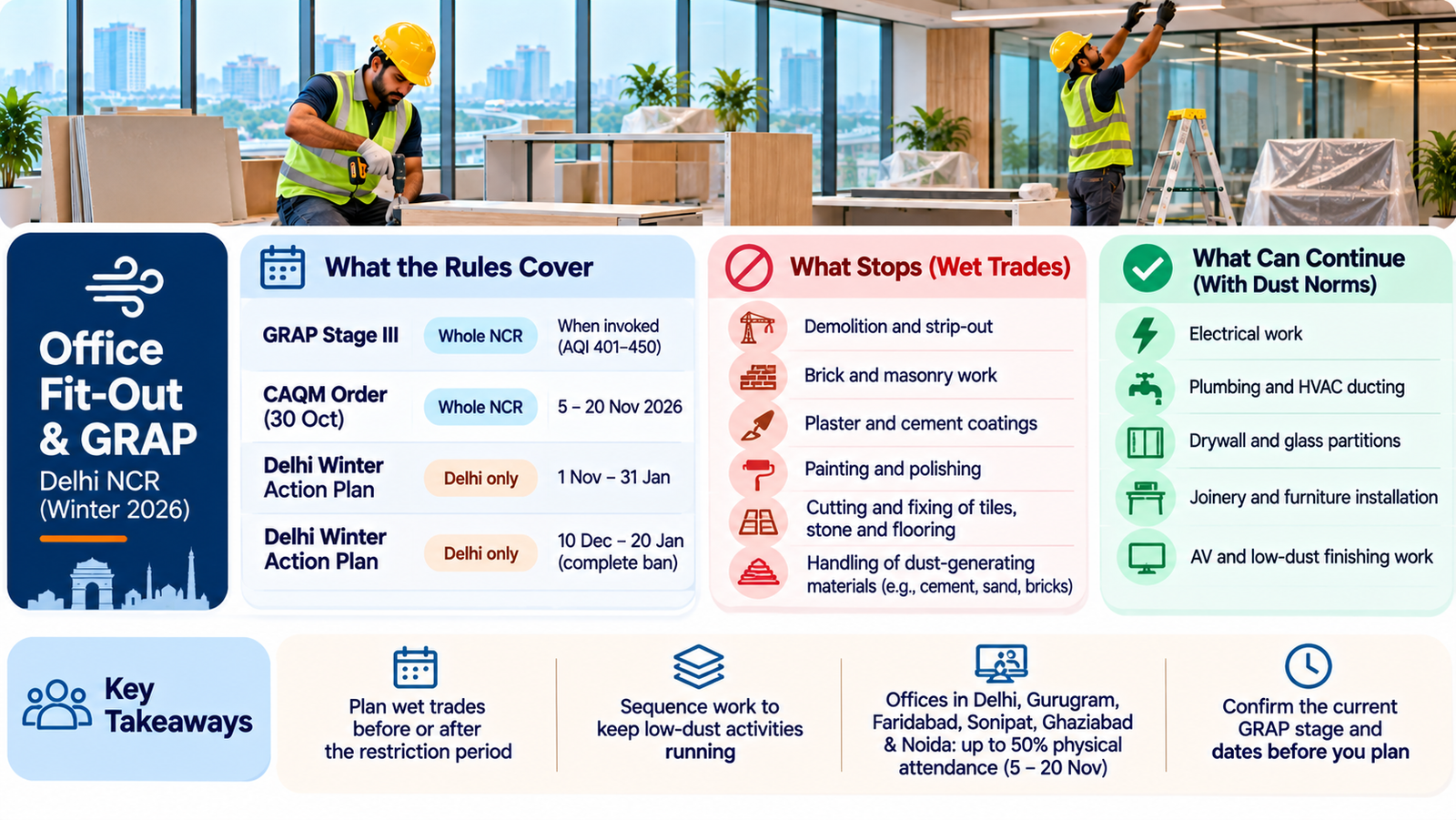
Under GRAP Stage III the dusty part stops. CAQM’s December 2025 Stage III order restricts all demolition, brick and masonry work, cement and plaster coatings, painting and polishing, the cutting and fixing of tiles, stone and other flooring, and the handling of dust-generating materials. Other construction that is relatively less polluting may carry on if dust norms are met.
That turns a winter fit-out into a question of sequence and specification. Do the wet trades before the restrictions start or after they end, and build as much of the floor dry as the design allows. Delhi adds a harder line, an announced complete construction and demolition ban from 10 December to 20 January, and the reporting leaves open whether indoor finishing is exempt from it. More on that below.
What is in force this winter
Where things stand: CAQM invoked Stage III across the NCR on 6 November, as a precaution, with Delhi’s AQI at 382 and severe readings forecast for 7 to 9 November. Stage II had been in force since 2 November. So the Stage III restrictions below are live now, alongside CAQM’s 5 to 20 November window.
Three sets of rules apply, and they overlap.
| Rule | Where | When | What it stops |
|---|---|---|---|
| GRAP Stage III | Whole NCR | When CAQM invokes it: AQI 401 to 450, or earlier on a forecast | The dust-generating activities on the Stage III list, covered below |
| CAQM order of 30 October | Whole NCR | 5 to 20 November 2026 | Dust-generating demolition and outdoor construction. Rail, metro, airports, inter-state bus terminals, hospitals, water supply and sanitation, defence and projects of national importance are exempt |
| Delhi Winter Action Plan | Delhi only | 1 November to 31 January | Dust-generating demolition and outdoor civil construction |
| Delhi Winter Action Plan | Delhi only | 10 December to 20 January | A complete ban on construction and demolition |
The same CAQM order tells offices in Delhi, Gurugram, Faridabad, Sonipat, Ghaziabad and Gautam Buddha Nagar to run at up to 50% physical attendance over the 5 to 20 November window. That affects a team still sitting on the floor you’re working on. Flying squads will watch for violations from 5 November, and the Tribune reports heavy fines for sites that breach the order. CAQM’s reason for the November window is in its own data: the order says its 2018 to 2025 data put the worst of the region’s pollution in the first and middle weeks of November.
Stage III is the wild card, and this winter it arrived on 6 November. Last winter it was in force from 11 to 26 November, from 13 December to 3 January and from 17 to 22 January, about 41 days across three spells. CAQM can also move before the reading gets there. On 17 January it invoked Stage III with the AQI at 354, which is “Very Poor”, not “Severe”. So the fixed dates are only part of your exposure.
What Stage III stops, trade by trade
The December order lists a named set of dust-generating activities and lets other “relatively less polluting” construction continue under dust norms. PIB’s summary of the September 2026 revision says it made a minor relaxation to that action, with pothole repairs as the example, so read the current schedule for the exact wording. This is how a typical office fit-out lines up against the December list.
| Fit-out task | On the Stage III list? | What follows |
|---|---|---|
| Strip-out of an old fit-out | Yes: all demolition works, and any transportation of demolition waste | The work stops, and so does the haul-out |
| Brick or block partitions | Yes: brick and masonry works | Dry-lined partitions or glass instead |
| Screed, plaster and cement coatings | Yes, except minor indoor repairs and maintenance | Schedule outside the window |
| Painting and polishing | Yes: painting, polishing and varnishing | Factory-finished surfaces avoid it |
| Tile and stone flooring | Yes: cutting, grinding and fixing of tiles, stones and other flooring materials, except minor indoor repairs | Check how the regulator treats carpet tile or vinyl before assuming |
| Cement, sand and brick deliveries | Yes: loading and unloading of dust-generating materials | Plan deliveries outside the window |
| Electrical, plumbing and HVAC ducting | Not named | Permitted if less polluting and dust norms are met. Minor welding for MEP work is expressly allowed |
| Drywall boarding, glass partitions, ceilings, joinery, furniture, AV | Not named | Permitted on the same terms, though the plaster and paint finishing over drywall is on the list |
The list is the wet trades. Dry work is permitted by omission, provided it is genuinely low-dust. The more of the floor you can build dry, the less a winter ban can do to your programme. That’s a design decision before it’s a scheduling one.
Gurugram and Noida against Delhi
Delhi’s rules are the hardest, and they cover Delhi only. For a floor in Delhi, the announced plan calls for a complete construction and demolition ban for 42 days, from 10 December to 20 January, inside a longer stretch from 1 November to 31 January in which dust-generating demolition and outdoor civil construction are prohibited. Gurugram and Noida sit under CAQM’s 16-day window from 5 to 20 November, plus GRAP whenever it’s invoked. We haven’t found a fixed seasonal ban for either beyond that, so ask your building management and the state pollution control board.
That doesn’t make Gurugram or Noida safe. GRAP applies across the NCR, and last winter’s Stage III spells alone ran to about six weeks.
The Delhi question the headlines don’t settle
Delhi’s announcement calls 10 December to 20 January a complete ban on construction and demolition. Time Out Delhi’s report of the plan adds that interior finishing, plumbing and electrical work can carry on if dust norms are followed. ANI’s report doesn’t say so, and none of the reports we found quotes the notification itself.
Until you’ve seen the notification text, or a written confirmation from Delhi’s Environment Department, treat indoor work in Delhi between those dates as unconfirmed, and plan so the programme still works if the answer is no. Time Out Delhi also reports that trucks carrying sand, cement, bricks or debris are barred from the city during that period, which would matter for screed and strip-out whatever the answer on indoor work.
How to plan a winter fit-out
Start with the wet trades, and treat strip-out as the hard one. In Delhi, dust-generating demolition is prohibited from 1 November to 31 January, so a strip-out that hasn’t started most likely moves to February. In Gurugram and Noida it is restricted from 5 to 20 November, and Stage III can stop it at any point.
The other wet trades are masonry, screed, tile work and painting. If they can finish before the restrictions start, or wait until they end, the rest of the programme can run through them. In Delhi that means before 10 December or after 20 January, assuming indoor finishing isn’t exempt.
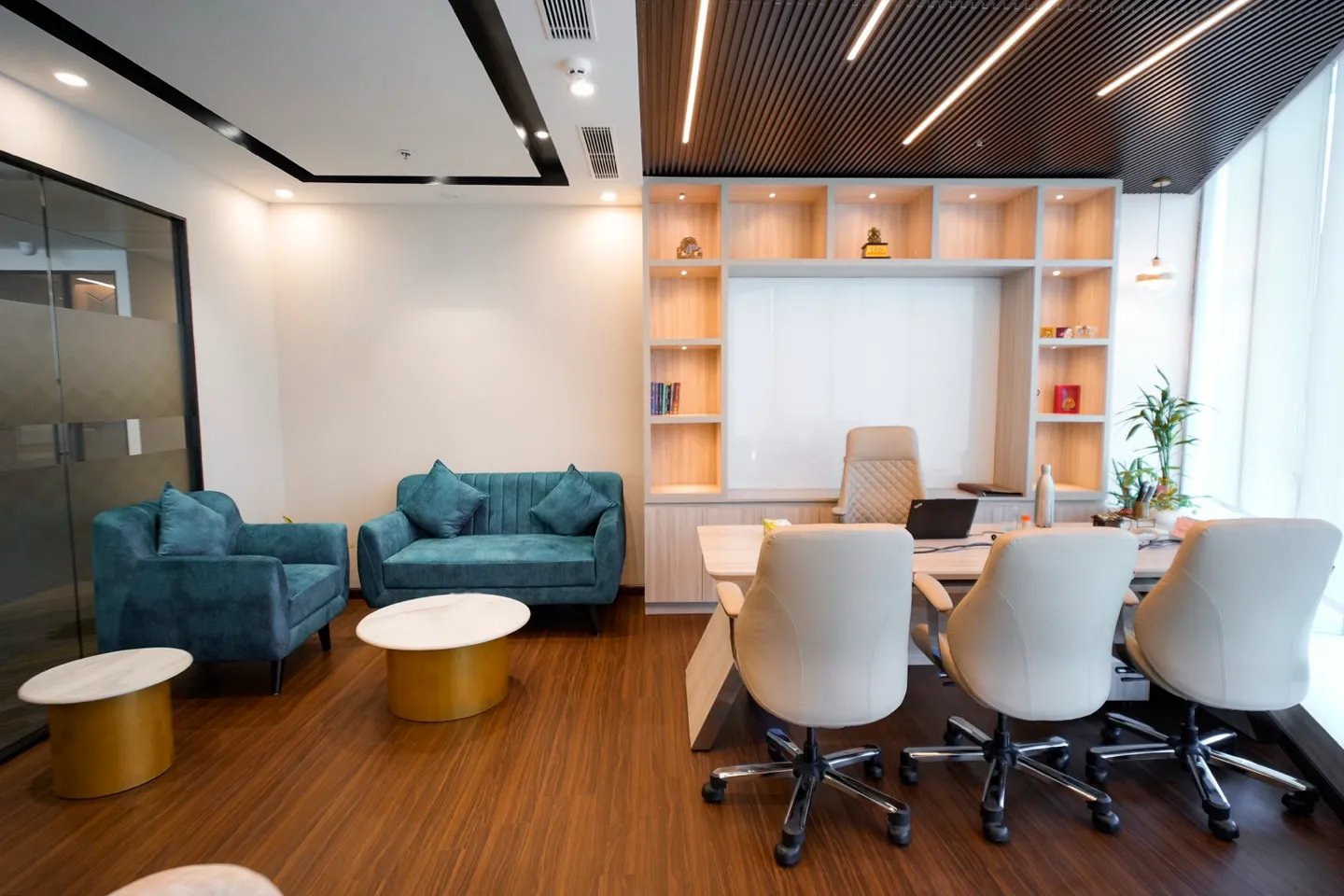
Then design the floor to need fewer of them. Drywall and glass partitions instead of block, and modular systems where they fit (flexible and modular office design). Factory-finished joinery and wall panels instead of site-applied paint. A floor finish chosen with the “other flooring materials” wording in mind. In winter the calendar belongs in the design brief, not only in the programme, and the place to settle it is the bespoke office interior design stage, before the drawings are fixed.
Write the stoppage into the contract. Who pays when an order stops the work, and does the programme move? Settle it in writing before the first stop order, not during it.
And comply even when you’re allowed to work. CAQM’s directions require construction and demolition projects on plots of 500 square metres or more to register on the state’s dust-monitoring portal, and the September revision extended that mechanism to eligible projects beyond municipal limits. Whether a fit-out inside a building falls under the building’s registration is a question for your building management, and it’s best asked before work starts. The cost of getting it wrong is real: when CAQM revoked Stage III last November, it added that sites closed for violations would not be allowed to resume unless the Commission specifically permitted it.
Questions to put to your contractor and your building
Ask in writing, before a winter programme is signed off.
| Question | Why it matters |
|---|---|
| Which trades in the programme are on the Stage III list, and on what dates do they fall? | The dates show how much of the programme is exposed |
| What is the fallback sequence if Stage III is invoked in week six? | A programme with no fallback stops entirely |
| How does demolition waste leave the site if a stage is invoked mid-strip-out? | Transporting demolition waste is itself on the list |
| Is the site registered on the dust portal, and who keeps it compliant? | CAQM’s registration directions apply to plots of 500 sq m or more |
| What flooring is specified, and has anyone checked it against the “other flooring materials” wording? | The list names cutting and fixing of flooring materials, not just tile and stone |
| In Delhi, do you hold the notification text, or written confirmation, covering indoor work from 10 December to 20 January? | The reporting doesn’t settle it |
| Who pays for a stoppage, and does the completion date move? | It is cheaper to agree before it happens |
What we can’t tell you
Rules this fast-moving need a margin for error, and here is ours. We haven’t seen the Delhi notification text, so the treatment of indoor work during the complete ban is unconfirmed. We’ve used the December 2025 Stage III order plus PIB’s summary of the September revision, not the revised schedule line by line. Coverage of the 6 November invocation lists demolition, excavation, piling and brickwork among the suspended work, which matches the December list, but we haven’t seen that order’s text. And whether a particular task, such as laying carpet tile, counts as fixing flooring materials is a call for the regulator on site, not for us or a contractor to make in advance.
Running an office fit-out through a Delhi NCR winter? Talk to Orange Offices. Bring the floor, the lease dates and the current programme, and we’ll show you where the wet trades fall and what a dry-built version would change.