On 6 November, Delhi’s average AQI was 382. At IIT Delhi and Rohini it was 474. Half your team was in that morning, under CAQM’s 50% attendance order, and somebody in facilities asked a fair question: what is this floor actually doing about the air?
If nobody can answer in a sentence, the answer was mostly settled long before the smog. It sits in the filters on the air-handling units, where the intakes are, how the partitions meet the return air, and where the pantry exhausts. Purifiers and plants, which is where a lot of advice starts, come well down the list.
The short answer
A fit-out can’t clean Delhi’s outdoor air. It decides how much of that air reaches your desks, how quickly indoor air is replaced, and whether anyone can see what’s happening. The most detailed guidance we found for buildings coping with weeks of fine-particle pollution comes from EPA and ASHRAE. It was written for wildfire smoke, and Health Canada’s 2025 guide for office buildings summarises it. It comes down to better filters, control over outdoor-air intake, a tight envelope, HEPA air cleaners as backup, and PM2.5 sensors. Several of those are fit-out decisions.
What the AQI number hides
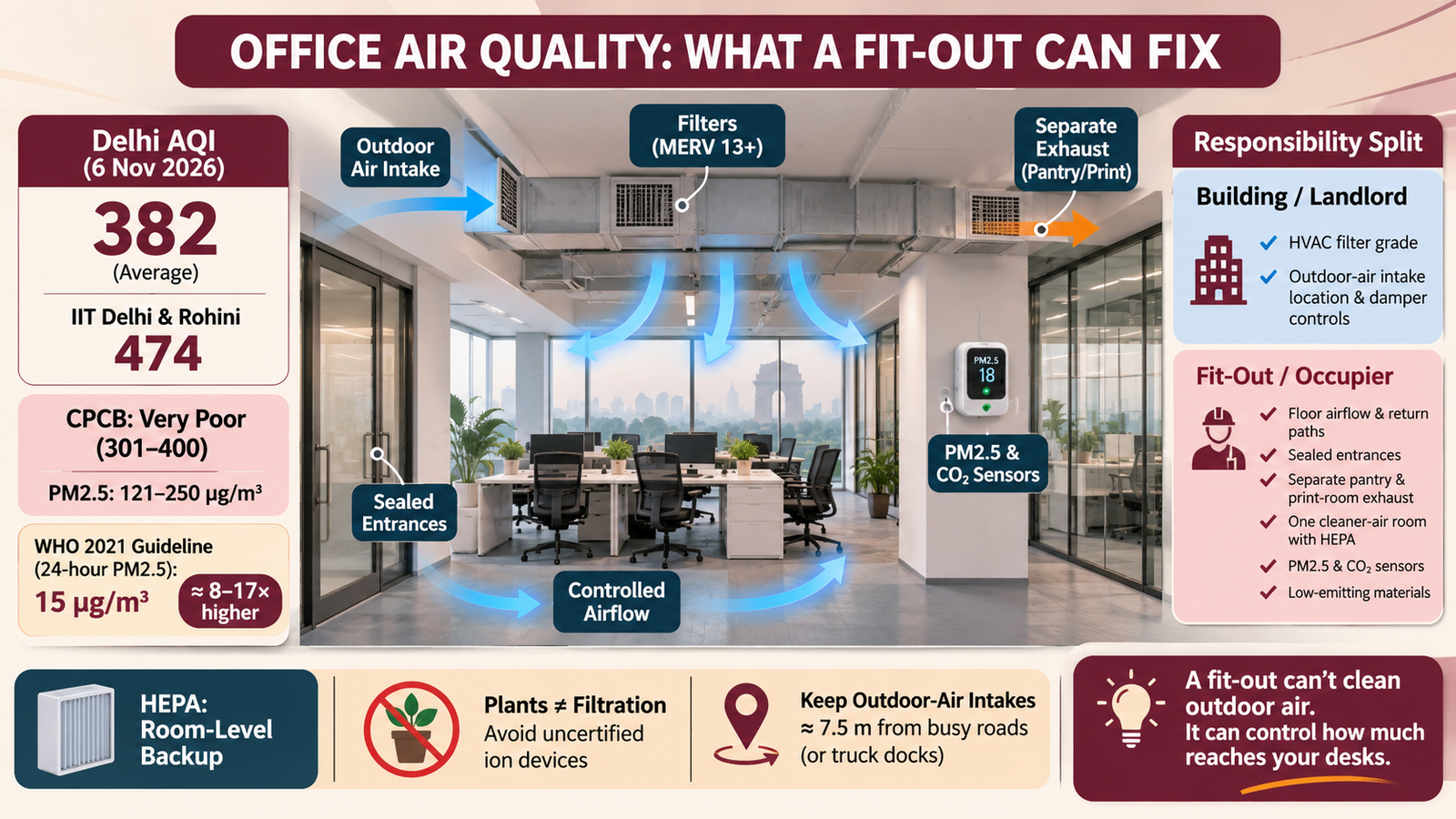
CPCB’s index takes the worst single pollutant. When that pollutant is PM2.5, a “Very Poor” reading (301 to 400) means 24-hour PM2.5 of 121 to 250 µg/m³, and “Severe” starts above 250. WHO’s 2021 guideline for 24-hour PM2.5 is 15 µg/m³. A Very Poor day therefore runs roughly eight to seventeen times the guideline, and the 474 at two stations on 6 November was Severe.
Those are outdoor readings. What reaches your desks depends on the building, which is the part you get a say in.
Fresh air versus clean air
A ventilation system works by bringing outdoor air in and sending indoor air out, and Health Canada is blunt that recirculating or filtering alone isn’t enough. In November that has a catch. The outdoor air is the pollutant. The same guide warns that adding outdoor air can bring in smoke, smog and traffic pollution.
Fresh air wasn’t generous even outside the smog season. CO₂ is the usual proxy for how much of it each person gets, and a 2017 study of two Delhi office buildings measured averages of 1,513 and 1,338 ppm, which the authors reported as much higher than the ASHRAE standard. So you can’t solve the smog problem by shutting the building up, and you can’t solve the stuffy-office problem by throwing the dampers open. A fit-out has to design for both.
What’s yours to specify, and what’s your landlord’s
In many multi-tenant towers the base-building air handling belongs to the landlord’s operator. Check your lease and the building’s specification. Your fit-out controls the floor, and it gives you standing to ask about the rest. (MERV, in the table, is the rating scale for HVAC filters: higher numbers catch more fine particles but resist airflow.) Here’s how the levers split.
| Lever | Usually whose call | What to specify or ask |
|---|---|---|
| Filter grade on the air-handling units | Building | What grade is fitted, and can the fans take MERV 13 or higher? Health Canada says to check the added pressure drop with an HVAC professional, and to fit a gauge so filter loading is visible. |
| Where outdoor air comes in | Building | How far are the intakes from roads, parking and loading areas, and do the dampers and controls work well enough to cut intake on bad days? Health Canada’s guide gives ASHRAE’s minimum separations, such as 7.5 m from a high-traffic road or a truck dock. |
| How air moves across your floor | Fit-out | Plan the return paths before the partitions go in. Health Canada tells renovators to plan for the airflow changes new partitions cause, and lists spaces used differently from their design among the factors that degrade indoor air. |
| Entrances | Fit-out | Seal the envelope and limit the ways in. EPA and ASHRAE advise weatherising and limiting entrances, and Health Canada adds slight positive pressure where possible. We’d also specify gasketed, self-closing doors, and a vestibule where the plan allows. |
| Pantry, print and copy rooms | Fit-out | We’d exhaust them directly outdoors rather than into a shared return. Health Canada lists kitchens and photocopy rooms as special areas, ASHRAE’s plan lists cooking and printers as indoor PM2.5 sources, and a NEERI study of a renovated Delhi office singled out canteen cooking. |
| A cleaner-air room | Fit-out and occupier | Give one room power, space and a door that closes, and put a HEPA air cleaner in it sized by its CADR, the rating for how much clean air it delivers. An air cleaner treats a room, not a building. |
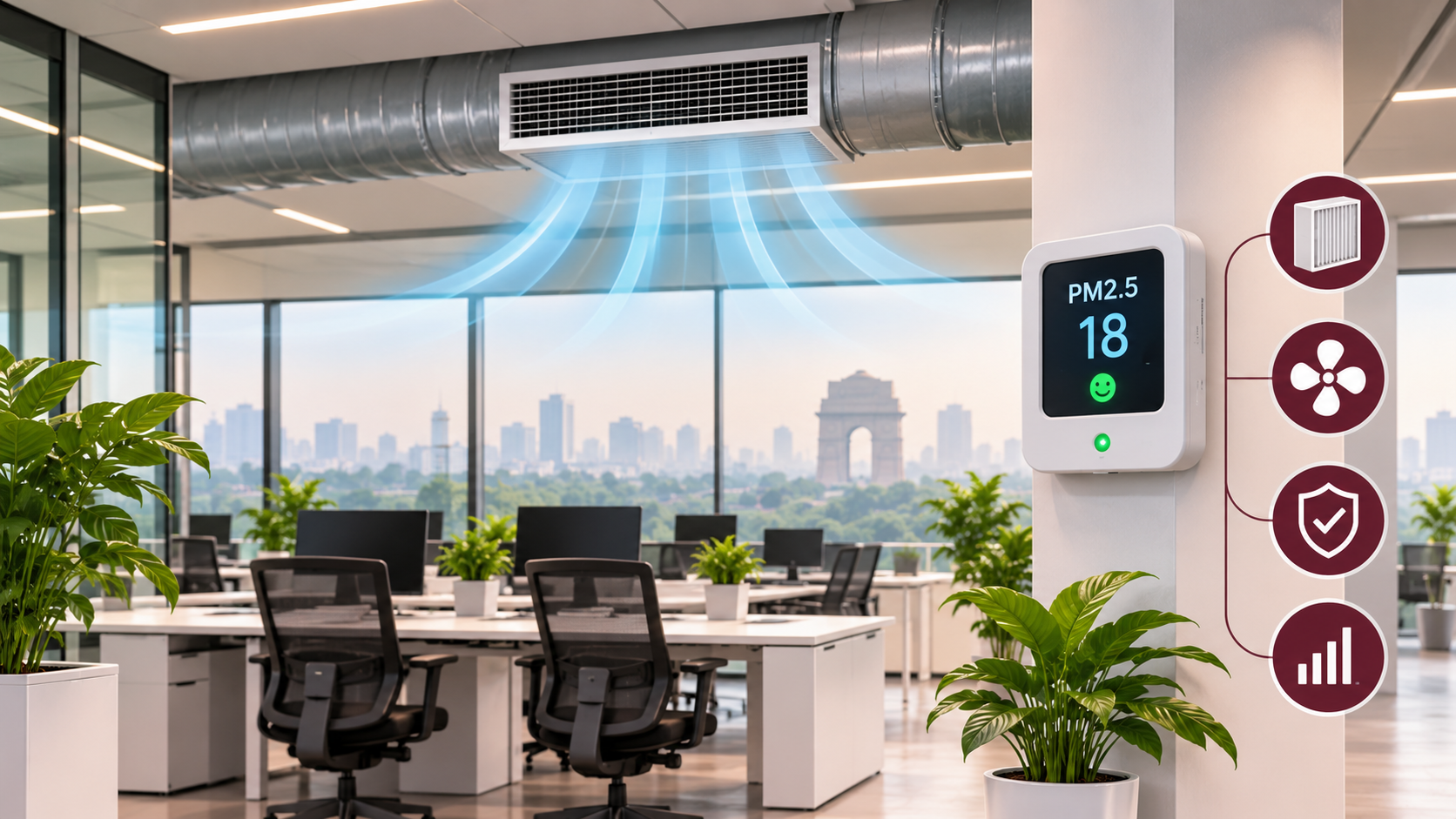
| Sensors | Fit-out | PM2.5 and CO₂ sensors, positioned with an HVAC professional. EPA says low-cost PM2.5 monitors show trends rather than exact values. Health Canada reads a rising trend as doors open, filters failing or air cleaners needing to go on. |
| Materials and sequence | Fit-out | Low-emitting products (see our eco-friendly workspace design work), new materials aired out before they come in, the work area sealed off from the air handling, and the system confirmed clean and balanced before people move back. If people stay on the floor during renovation, Health Canada also wants the work areas isolated. |
Two things that don’t belong in the brief
Plants are good for a floor. They aren’t filtration. A 2020 review took 196 results from 12 chamber studies and converted them into clean air delivery rates. To match the VOC removal that ordinary ventilation already gives, you’d need 10 to 1,000 plants per square metre of floor. The review covers VOCs, and we found nothing to suggest plants do better against fine particles. The authors treat wellbeing benefits as a separate question, which is where they belong.
Gadgets that clean air with ions, photocatalytic oxidisers or electrostatic precipitators can produce ozone. Health Canada says to look for UL 2998 certification, which means zero ozone emissions, and to avoid the device if it doesn’t have it.
Portable HEPA units are fine, as backup for one room. Health Canada says they work alongside building ventilation and are not a substitute for it.
What a fit-out can’t fix
It can’t change the air outside. It can’t upgrade a landlord’s air-handling unit if the landlord won’t. Filters don’t touch gases either: Health Canada says they’re generally not effective against gases such as CO and CO₂, so filtration sits alongside ventilation, not in place of it. And nobody honest can promise you an indoor AQI figure for a floor they haven’t measured. Sensors are how you find out.
The costly version of all this is learning in November that the fans can’t take a better filter. The cheap version is asking in the brief.
What we haven’t checked
We’ve leaned on EPA and ASHRAE guidance through Health Canada’s 2025 summary, plus WHO and CPCB. We haven’t checked what India’s National Building Code or ISHRAE say about office filtration. The guidance was written for wildfire smoke, not Delhi’s winter pollution, so treat the logic as transferable and the numbers as starting points. Your HVAC consultant should confirm local code and equipment limits before anything above is specified.
Briefing a fit-out for Delhi NCR’s pollution season? Talk to Orange Offices. Bring the lease, the base-building HVAC specification if you have it, and the floor plan. We’ll mark where each of these levers sits and what to ask your landlord.