Walk into most Delhi NCR offices at 2pm and you’ll see the same thing. Harsh overhead lights blasting the same colour temperature they’ve been blasting since 8am. People squinting at screens. Some with desk lamps aimed wrong. Others sitting in shadow zones created by ceiling grids. Nearly everyone tired by mid-afternoon despite multiple coffees.
The problem isn’t brightness. Most offices hit recommended lux levels. The problem is that lighting design stopped at “can people see their desks” and never asked “does this support how human biology actually works.”
Your eyes aren’t cameras. They’re sensors that feed your brain information about time of day, which regulates sleep-wake cycles, hormone production, core body temperature, and cognitive performance. Get the lighting wrong and you’re fighting your employees’ biology for eight hours daily.
Orange Offices treats lighting as biological infrastructure. Research is clear: workers exposed to high circadian stimulation in the morning report better sleep quality and fewer depressive symptoms according to studies in office buildings. The reverse is also true—static lighting disconnected from natural day-night cycles creates what researchers call “social jet lag,” where your body clock never properly syncs with your work schedule.
For Delhi NCR offices where talent retention matters and medical leave costs money, lighting design that accounts for human circadian rhythms delivers returns through reduced absenteeism, better daytime alertness, and yes, people actually sleeping properly at night.
What Your Eyes Are Telling Your Brain (And Why It Matters)
Light enters your eyes through specialized cells called intrinsically photosensitive retinal ganglion cells. These aren’t involved in seeing—they’re biological sensors feeding the suprachiasmatic nucleus, your brain’s master clock.
Blue wavelengths (around 480 nanometers) tell your brain it’s daytime. They suppress melatonin production. You feel alert. Your core temperature rises slightly. Cognitive performance peaks.
Absence of blue wavelengths tells your brain it’s evening. Melatonin production increases. Your body prepares for sleep. If you’re getting blasted with 6500K cool white LEDs at 7pm, you’re sending the biological signal for noon. Then you go home, struggle to fall asleep, wake up groggy, arrive at the office already tired. Repeat daily.
The problem compounds in Indian office environments. Most people arrive at work around 9am during winter months when it’s still relatively dark outside. They enter artificially lit buildings, sit under unchanging overhead lights for 8-9 hours, then leave after sunset. Total natural light exposure: maybe their commute, if they’re lucky.
Research shows this matters more than most companies realize. Studies tracking office workers found those receiving high circadian stimulation throughout the workday reported better sleep and reduced depressive symptoms compared to workers in poorly lit environments. The difference wasn’t subjective feeling—it showed up in objective sleep quality metrics.
The Three-Layer Lighting Hierarchy That Actually Works
Good office lighting isn’t one thing. It’s a system with three distinct layers serving different functions.
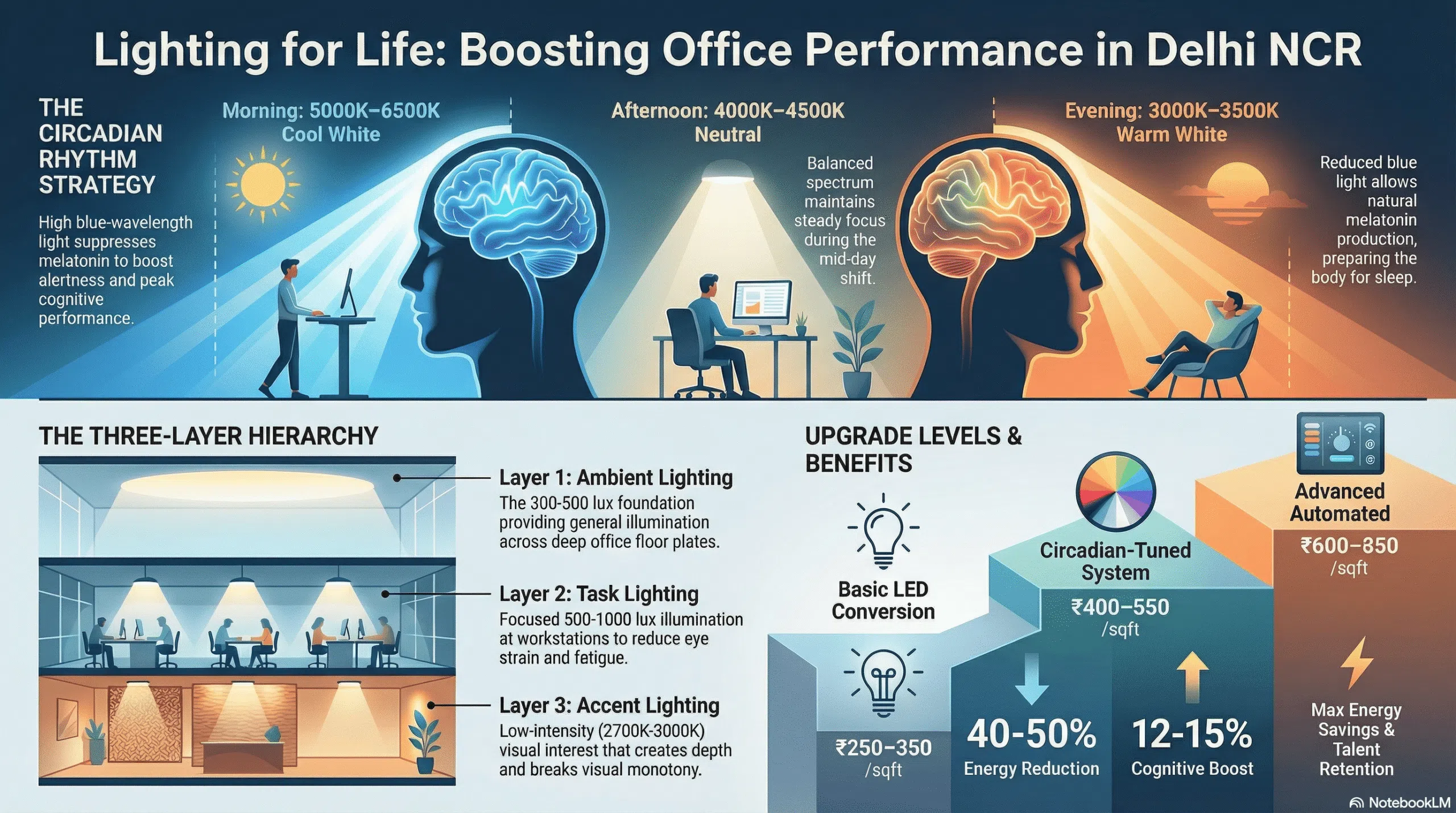
Ambient Lighting: The Foundation
This is your general illumination. Ceiling-mounted fixtures providing base light levels across the space. Target: 300-500 lux for general office areas, 500-750 lux for detailed work zones.
In Delhi NCR offices, ambient lighting needs to solve two problems. First, deep floor plates common in commercial buildings don’t get natural light penetration beyond 4-5 meters from windows. Second, ceiling heights often run 2.7-3 meters, which creates specific mounting and distribution challenges.
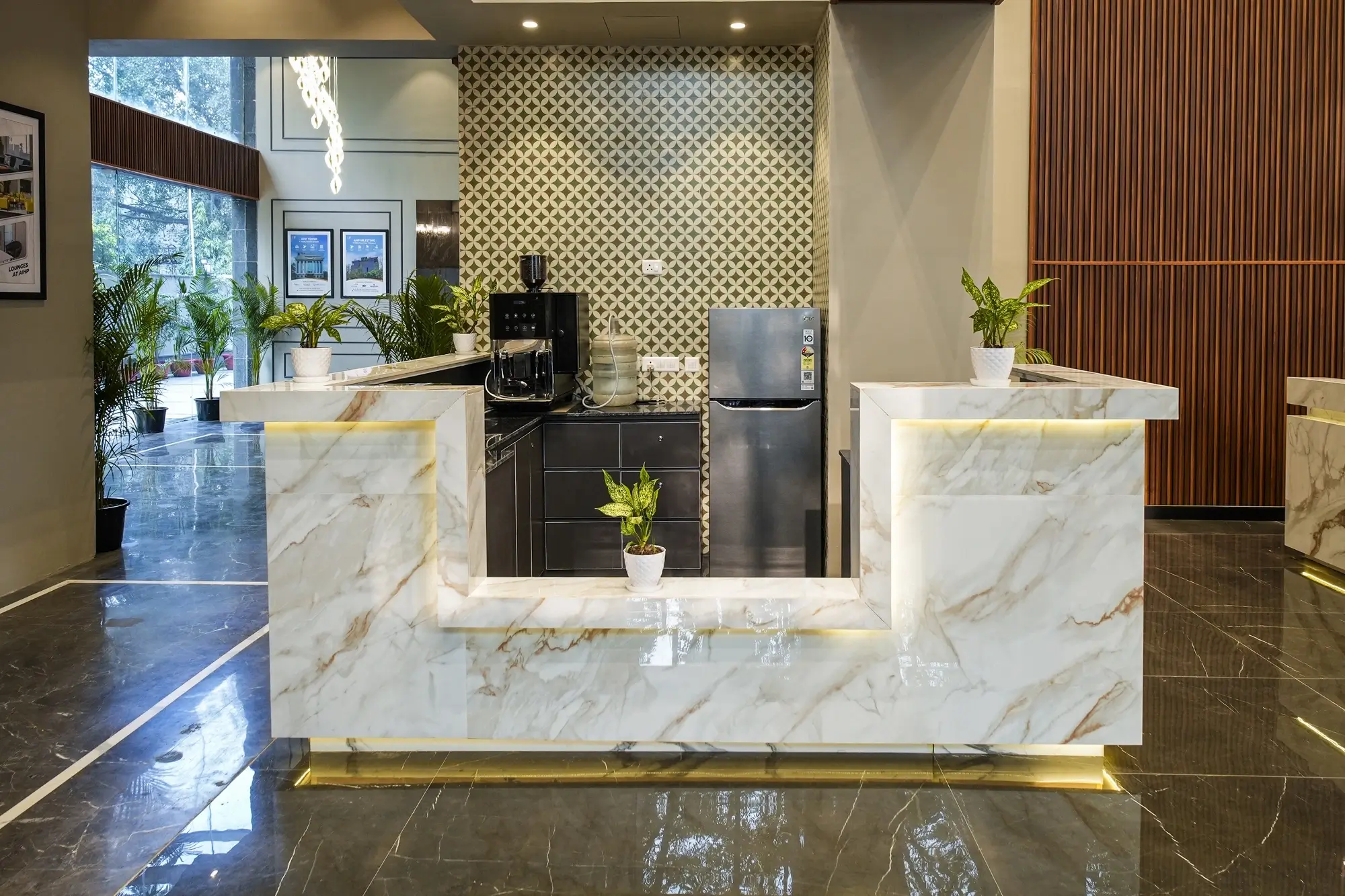
LED panels work well here—flat profile, even distribution, dimmable for circadian tuning. Color temperature should be variable if possible. Morning hours benefit from 5000-6500K (cool white, high blue content). Afternoon shifts to 4000-4500K (neutral). Late day drops to 3000-3500K (warm white, reduced blue).
The worst choice is fixed fluorescent tubes running 4000K all day. No biological signal variation, no support for circadian rhythm, and they flicker at 50-60Hz which causes subtle eye strain over hours of exposure.
Task Lighting: Where Work Actually Happens
Ambient lighting creates the base. Task lighting adds focused illumination where people need it—desk surfaces, reading areas, detailed work zones. Target: 500-1000 lux depending on task complexity.
For office design in Delhi NCR, task lighting solves the mismatch between generic overhead lighting and specific work requirements. An analyst reviewing spreadsheets needs different light than someone in a video call needs different light than someone sketching.
Adjustable desk lamps give workers control. This matters psychologically—studies show people who can adjust their lighting report higher satisfaction and perceived control over their environment. Functionally, it lets people tune brightness and direction based on actual need, which reduces eye strain compared to one-size-fits-all overhead systems.
Color temperature for task lighting should match the time of day if you’re doing full circadian design, or stick to neutral 4000K if that’s too complex. Avoid mixing warm and cool sources in the same workspace—your eyes constantly readjust and it’s tiring.
Accent Lighting: The Layer Nobody Thinks About But Everyone Notices
This isn’t functional illumination. It’s visual interest. Uplighting on walls. Cove lighting on ceilings. Backlit branding elements. Feature lighting on architectural details.
Accent lighting makes spaces feel designed rather than assembled. It breaks up the visual monotony of uniform overhead grids. In bespoke office interior design, accent lighting differentiates zones, creates hierarchy, and yes, makes the office photograph better.
Keep accent lighting warm (2700-3000K). It adds depth and contrast against cooler ambient and task lighting without interfering with circadian signals.
Delhi NCR’s Specific Lighting Challenges
Standard lighting advice needs adaptation for Indian commercial environments.
Intense Direct Sunlight and Glare Management
Delhi’s latitude (28°N) means strong, direct sunlight especially during summer months. South and west-facing facades can create brutal glare problems from mid-morning through afternoon.
Untreated, this makes workstations near windows unusable for screen-based work. People pull blinds closed, which defeats the entire purpose of having windows. The office stays artificially lit all day despite abundant natural light outside.
Solutions stack. External shading (horizontal sunscreens, vertical louvers) blocks direct sun before it enters. Light-colored blinds or sheer curtains diffuse rather than block. Interior light shelves—horizontal reflective surfaces mounted above eye level on windows—bounce light up to ceilings, spreading it deeper into the floor plate while reducing direct glare at desk height.
Glass partitions help distribute natural light deeper into floor plates, but they need to be positioned based on sun angles not just aesthetics. An east-west glass wall does nothing for north-south light penetration.
Deep Floor Plates and Light Penetration
Commercial real estate in Gurgaon and Noida often features floor plates 20-30 meters deep. Natural light penetrates roughly twice the window height—so a 3-meter window lights maybe 6-7 meters into the space effectively. The center zones stay dark.
This is where ceiling-reflected indirect lighting becomes important. By bouncing light off white or light-colored ceiling surfaces, you distribute it more evenly than direct downlights create. Combined with light-colored wall finishes (matte white, light gray, soft beige), you can push effective light distribution deeper.
For modern office renovation in existing buildings with deep floor plates, central atrium strategies rarely work (too expensive, too disruptive). Focus instead on maximizing perimeter light distribution, high-quality artificial lighting in core zones, and task lighting that compensates for ambient deficits.
Energy Costs and AC Load
Lighting generates heat. In Delhi’s climate where AC runs 8+ months annually, this matters. Every watt of lighting power is a watt of heat the AC system must remove.
LEDs help substantially—they run cooler than fluorescents or halogens. A typical 40W LED panel produces equivalent light to a 120W fluorescent fixture while generating one-third the heat load. Over hundreds of fixtures, that’s significant AC savings.
Automated dimming based on natural light availability (daylight harvesting) cuts energy further. Sensors detect ambient light levels and reduce artificial lighting when sufficient daylight is available. In perimeter zones, this can reduce daytime lighting energy by 40-60%.
Circadian Lighting Implementation: What Actually Works
Full circadian lighting systems sound expensive and complex. They can be. But you can capture 70-80% of the benefit with simpler approaches.
Baseline: Time-Staged Static Lighting
The simplest version uses three programmed scenes: morning (6500K, higher intensity), midday (4500K, moderate intensity), afternoon/evening (3000K, lower intensity). No sensors, no automation, just scheduled timing.
This costs marginally more than static lighting—you need dimmable LED fixtures capable of color temperature tuning. Add maybe 15-20% to fixture costs. Installation is the same. Programming is one-time setup.
Benefits: Better circadian support than static lighting, reduced evening melatonin suppression, subjective reports of improved alertness and better sleep quality.
Mid-Tier: Daylight-Linked Automatic Systems
Add sensors that detect natural light levels. The system automatically dims artificial lighting when sufficient daylight is available (saving energy) and adjusts color temperature based on time of day and ambient conditions.
Costs rise 35-50% compared to static systems because of sensors, control systems, and integration. But energy savings offset some costs—typically 30-40% reduction in lighting energy consumption in perimeter zones.
Benefits: Full circadian support, substantial energy savings, reduced glare (sensors can detect excessive brightness and trigger shades or dimming), adaptive response to cloudy vs sunny days.
Advanced: Personalized Circadian Optimization
This is where it gets exotic. Systems that track individual circadian rhythms (via wearables or self-reported sleep data) and customize lighting exposure to each person’s needs. Researchers have built these in university settings. Commercial viability is questionable outside of headquarters showpiece environments.
For most Delhi NCR offices, mid-tier automated systems deliver the best cost-benefit ratio. You get real circadian benefits, energy savings that help justify costs, and a system that actually works without requiring daily manual adjustment.
Lux Levels, Color Temperature, and Other Numbers That Matter
Here’s what the research and standards actually say, translated to practical targets.
Lux Requirements by Zone
General office areas: 300-500 lux. Sufficient for navigation, casual conversation, light reading. Too low causes eye strain. Too high wastes energy and can feel harsh.
Workstations with screens: 500-750 lux. Computer work benefits from moderate levels. Too bright causes screen glare. Too dim makes paper documents hard to read.
Detailed technical work: 750-1000 lux. Drawing, inspection, fine assembly. Higher precision needs more light.
Meeting rooms: 300-500 lux general, with capability to boost to 750+ for presentations requiring note-taking. Dimmable controls let you adjust based on use.
Break rooms and casual zones: 200-300 lux. Lower intensity supports relaxation without feeling dingy.
Color Temperature Timing
Morning (6am-11am): 5000-6500K. High blue content suppresses melatonin, increases alertness, supports focus. This is “wake up” lighting.
Midday (11am-4pm): 4000-4500K. Neutral white maintains alertness without feeling harsh. Balanced spectrum for general work.
Late afternoon/evening (4pm onwards): 3000-3500K. Warm white reduces blue content, allows natural melatonin production to begin. This is “wind down” lighting that prepares people for evening.
The transition between stages should be gradual—30-60 minute fades. Sudden shifts feel jarring and defeat the circadian purpose.
Glare Metrics
Unified Glare Rating (UGR) should stay below 19 for screen-based office work. Above 22, people report discomfort. Above 25, it impacts performance.
Achieving low UGR requires diffused lighting (not point sources), proper fixture positioning (avoid direct line of sight to bulbs), and matte finishes on surrounding surfaces. Glossy desks, shiny monitors, and reflective flooring all contribute to glare problems.
Cost Structures and Real ROI Calculations
Lighting upgrades span a wide range depending on scope and sophistication.
Basic LED Conversion
Replace existing fluorescents with LED panels, maintain current layout and control systems. Cost: ₹250-350 per square foot including materials and installation.
Savings: 40-50% lighting energy reduction, lower AC load, reduced maintenance (LEDs last 50,000+ hours vs 15,000 for fluorescents). Payback: 3-4 years through energy savings alone.
This doesn’t add circadian benefits, but it’s a good first step that improves economics while preparing infrastructure for future upgrades.
Circadian-Tuned LED System
Full color-temperature-tunable LED system with time-based programming. Cost: ₹400-550 per square foot.
Savings: Energy reduction plus productivity improvements. Research shows 12-15% improvement in cognitive performance during peak circadian-aligned hours. For knowledge workers with loaded costs of ₹1 lakh monthly, capturing even 5% productivity improvement represents ₹5,000 per person monthly. In a 100-person office, that’s ₹60 lakh annually.
Payback: 2-3 years when productivity gains are factored, 4-5 years on energy alone.
Advanced Automated System with Daylight Harvesting
Full circadian tuning plus sensors, automated dimming, glare management, and integration with building management systems. Cost: ₹600-850 per square foot.
Savings: Maximum energy reduction (50-60%), full circadian benefits, reduced facility management burden through automation. Adds employee satisfaction benefits that show up in retention metrics.
Payback: 3-4 years inclusive of productivity and retention improvements. Longer on energy alone but the human factors justify the investment for companies competing for talent.
Implementation Without Tearing Everything Down
Most offices can’t shut down for weeks while lighting gets rebuilt. Phased approaches work.
Phase 1: Meeting Rooms and High-Impact Zones
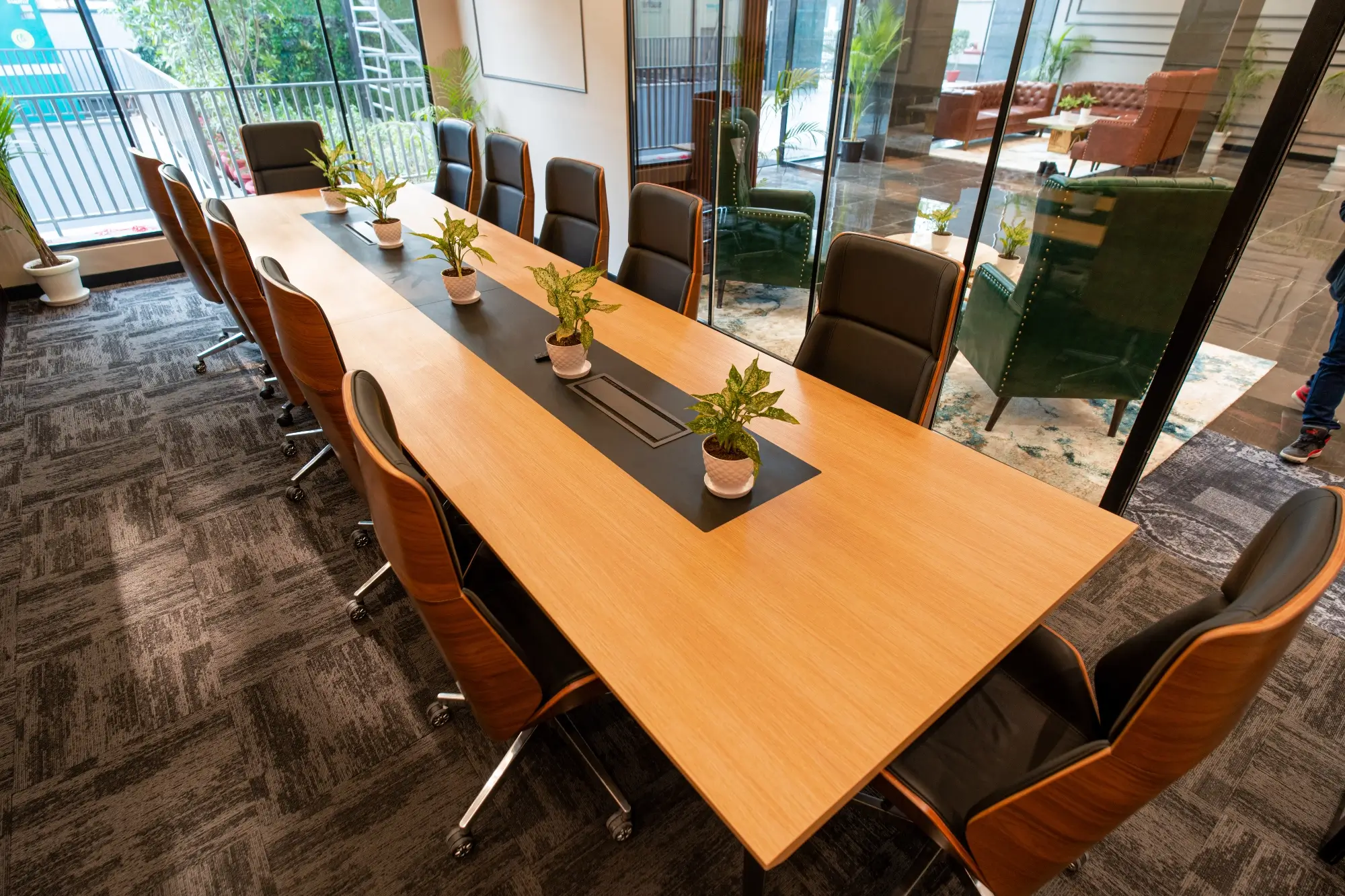
Start with spaces where everyone experiences the upgrade. Meeting rooms get full circadian systems. Reception areas get aesthetic + functional improvements. Break rooms get warmer, more comfortable lighting.
Why this works: High visibility, relatively low square footage (so manageable costs), immediate user feedback. If people notice and like it, support for wider rollout builds.
Phase 2: Perimeter Zones
Workstations near windows get automated daylight harvesting and glare management. These zones have the most complex lighting challenges (mixing natural and artificial light, glare control) and deliver the highest energy savings.
Phase 3: Core Zones
Interior workstations get circadian-tuned LED replacements. By this point, you have experience with the system, worked out installation kinks, and can move faster.
Total timeline: 6-12 months depending on office size. Work happens mostly after hours or on weekends, so disruption stays minimal.
Common Mistakes That Waste Money
Mistake 1: Uniform Lighting Everywhere
Treating the whole office like it needs identical light. Sales floors, focus areas, collaboration zones, and break rooms have different needs. Uniform lighting means everything’s wrong somewhere.
Mistake 2: Ignoring Controls
Installing great tunable LEDs but leaving them at factory defaults. Without proper programming or user controls, you spent money on capability you’re not using.
Mistake 3: Forgetting About Glare
Hitting lux targets while creating visual discomfort through direct glare, reflections, or high-contrast zones. People will close blinds, add desk plants to block ceiling lights, or complain constantly.
Mistake 4: Spec’ing on Price Alone
Cheap LED fixtures fail early, produce poor color rendering (making people look unwell on video calls), or create flicker even when dimmed. Initial savings evaporate in replacement costs and user dissatisfaction.
Mistake 5: No Maintenance Plan
LEDs last 50,000 hours in theory. In dusty Delhi environments with temperature swings and power fluctuations, actual lifespan is shorter. Without cleaning and periodic replacement planning, performance degrades.