A Noida IT company hired a designer based on portfolio and quotation. No formal contract existed beyond an Excel spreadsheet and WhatsApp messages. They paid 50% upfront for “material procurement.”
Three months passed. No work commenced. The designer stopped responding to calls, gave changing excuses, and refused to provide written project updates or timelines.
The company had paid ₹12 lakh with zero recourse. Their lawyer explained that whilst a verbal contract exists legally, proving scope, timelines, and deliverables without written documentation becomes expensive litigation lasting years.
A proper contract would have prevented this entirely through payment milestones, defined timelines, written communication requirements, and clear termination clauses.
Orange Offices has worked on hundreds of bespoke office interior design projects across Delhi NCR. We’ve seen what happens when contracts are vague, rushed, or absent. This guide explains what your contract should contain, red flags signalling problems, and how to structure agreements that protect your interests.
Why Written Contracts Matter
Delhi NCR’s Consumer Protection Act 2019 and Indian Contract Act 1872 protect buyers, but litigation is expensive and time-consuming. Disputes over design work typically take 18-24 months to resolve through Consumer Courts, during which your office sits half-finished.
Prevention costs less than cure. A well-drafted contract takes 2-3 hours to negotiate properly. Resolving disputes without one takes months or years.
Recent cases document ₹35 lakh payment frauds involving collusion between designers and clients, GST manipulation used as pressure tactics, and work stopped mid-project when designers abandon sites. Common threads: vague scope, verbal agreements, frontend-loaded payments.
Written contracts create accountability. They document what was agreed, when milestones occur, how payments work, and what happens when things go wrong. Both designer and client benefit from clarity.
Verbal agreements are legally binding in India, but proving their terms requires evidence like payment receipts, quotations, and message records. This evidence-gathering process is painful. Starting with written documentation is simpler.
Essential Contract Components
A complete office design contract covers seven critical areas.
Parties and project details: Full legal names and addresses of both parties, company registration numbers and GST details, project address and description, and contract date and duration. This basic information sounds obvious but gets skipped in rushed agreements.
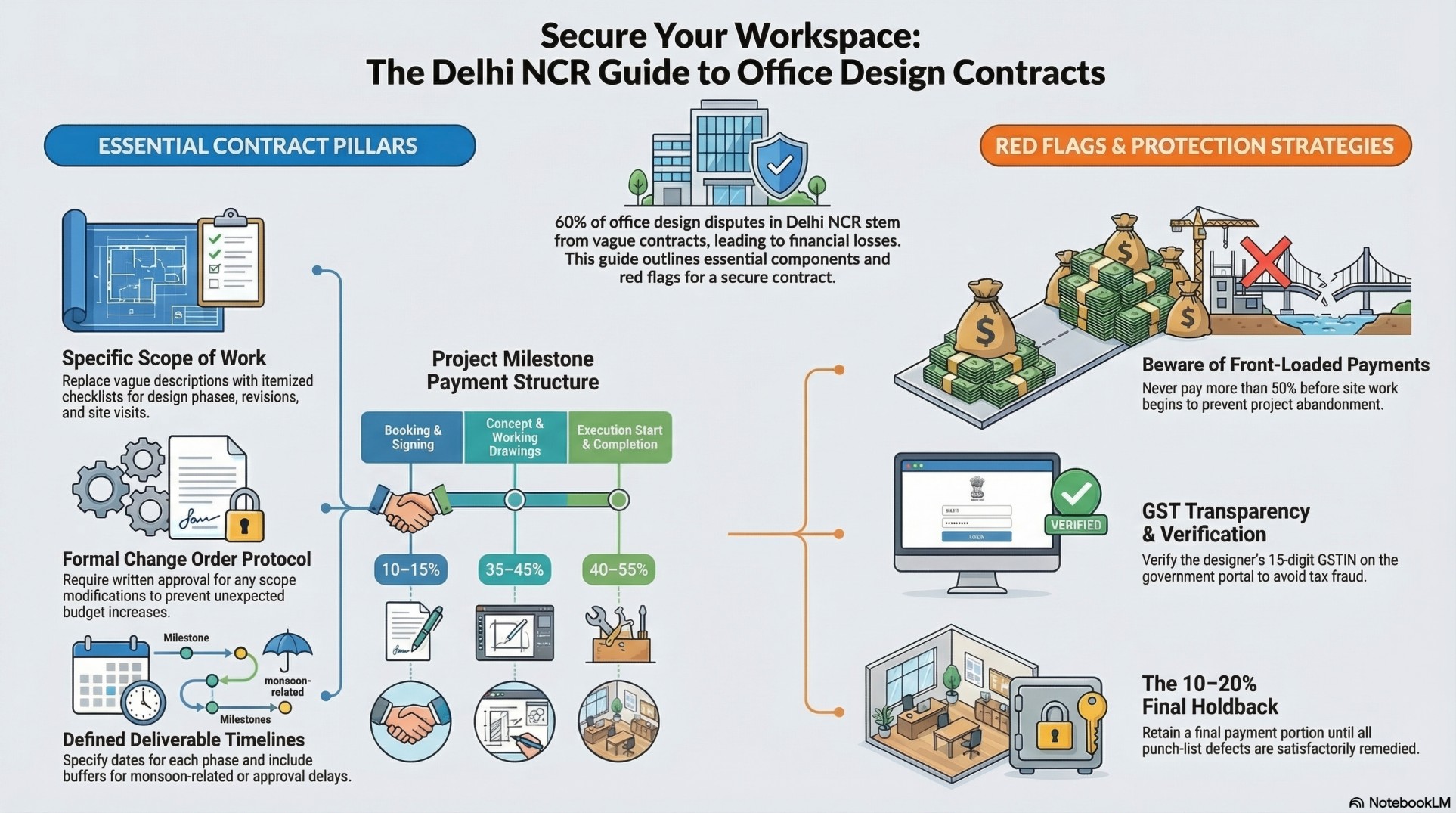
Scope of work: This is where most disputes originate. Vague scope statements like “complete interior design services” create problems. Detailed scope lists exactly what the designer provides.
For office projects, scope should specify design phases (concept, preliminary, working drawings), number of revisions included at each phase, site visits frequency during execution, coordination with contractors and vendors, procurement services (if applicable), and project management extent.
Common scope exclusions to clarify: structural modifications requiring separate engineers, MEP system design (electrical, plumbing, HVAC), furniture procurement vs just specification, contractor supervision vs occasional site visits, obtaining statutory approvals and permissions.
The scope should read like a checklist, not a paragraph. If a service matters to you, it should be explicitly listed. Assumptions create disputes.
Fee structure and payment terms: Office design fees in Delhi NCR follow four models.
Hourly billing works for smaller projects or evolving scope. Designers charge ₹2,000-8,000 per hour depending on experience. This model requires detailed time tracking and regular invoicing.
Fixed fees suit well-defined projects with clear scope. Total amount is agreed upfront, typically ₹3-15 lakh+ depending on office size and complexity. Changes to scope trigger additional fees through change orders.
Percentage of project cost means designer charges 10-20% of total execution budget. This aligns designer incentives with project budget but can create conflicts if designer wants higher budgets whilst client wants lower costs.
Cost-plus involves designer charging for their time plus markup on purchased materials. Common in high-end projects but requires transparency about markups. Some designers charge 15-30% markup on furniture and materials.
Your contract should state which model applies, exact amounts or rates, and when fees are payable.
Payment milestones: Delhi NCR projects typically use phased payments tied to deliverables rather than lump sums upfront.
Standard milestone structure includes booking/signing (10-15%), concept design approval (15-20%), working drawings completion (20-25%), execution start (20-25%), and completion/handover (remaining 20-30%).
Each payment should be tied to deliverables you can verify. “Design approved” is vague. “Client signs off on working drawings with material specifications and furniture layouts” is specific.
Never pay more than 50% before work commences on site. Frontend-loaded payments remove accountability. Designers who demand 70-80% upfront before execution starts should raise concerns.
According to JLL’s India office fit-out analysis, payment terms significantly affect project delivery timelines. Balanced milestone payments create natural checkpoints keeping projects on track.
Timeline and deliverables: Realistic timelines with buffer for approvals prevent disputes. Your contract should specify deliverable dates for each design phase, execution duration for physical work, and final completion/handover date.
Include buffer time for client approvals. If you take two weeks to approve concept designs, the working drawings phase starts two weeks later. Contracts should clarify that client approval delays extend subsequent timelines proportionally.
Delhi NCR’s monsoon affects execution. June-September timelines should account for weather delays. Contracts can include force majeure clauses for genuinely unforeseeable events.
What happens when deadlines are missed? Some contracts include liquidated damages clauses where designer pays penalty for delays. Others simply allow termination after reasonable notice. Define consequences upfront.
Change order process: Project scope changes during execution. You realise you need additional electrical points, change furniture specifications, or add a meeting room that wasn’t originally planned.
Change orders document these modifications. A proper change order includes description of change, cost impact (additional or credit), timeline impact, and approval signatures from both parties.
Require written change orders for any scope modification. Verbal approvals create disputes about what was agreed and whether payment is due. “Please add two more workstations” via WhatsApp should trigger formal change order documenting the ₹80,000 cost increase.
Termination clauses: Either party should be able to exit with reasonable notice. Standard termination clauses specify notice period required (typically 30 days), payment for work completed to termination date, return of drawings and intellectual property, and handover process for transitioning to another designer.
If you terminate after designer completes working drawings but before execution starts, you pay for design phase work completed. If designer terminates mid-project without cause, they may forfeit portions of fees and must provide drawings allowing project continuation.
Dispute resolution: When disputes arise, how will they be resolved? Options include negotiation between parties, mediation with neutral third party, arbitration with binding decision, or court proceedings.
Many contracts specify arbitration to avoid lengthy court cases. Arbitration clauses should name arbitration location (Delhi, Noida, or Gurgaon), number of arbitrators, and applicable laws.
Some disputes qualify for Consumer Court under Consumer Protection Act 2019 as “deficiency in service.” Filing is simpler than civil court but limited to consumer transactions, not complex commercial disputes.
Red Flags Before Signing
Certain warning signs indicate problems ahead.
Refusal to provide written contract: If a designer won’t provide formal written agreement, claiming “we work on trust” or “contracts aren’t necessary for smaller projects,” walk away. This indicates either inexperience or intention to avoid accountability.
Verbal agreements are legally valid but proving their terms is your burden. Why create that problem when written documentation is simple?
Vague scope statements: “Complete interior design services” or “turnkey execution” without itemised deliverables hides what’s actually included. You might assume site supervision is included whilst designer considers it extra.
Demand detailed scope. If designer resists specificity, claiming “it depends on project needs,” that’s a red flag. Professional designers provide clear scope statements.
Frontend-loaded payments: Paying 60-80% before work starts removes designer accountability. Standard practice is 10-15% booking, 15-25% at concept approval, balance during execution.
Designers requesting majority payment upfront should explain why. “We need to order materials” is reasonable for furniture procurement but not for design fees. Materials can be invoiced separately with verified procurement costs.
No GST clarity: Your contract should specify whether quoted amounts include or exclude GST. GST on construction and design services is 18%. A ₹10 lakh quote becomes ₹11.8 lakh after GST unless explicitly inclusive.
Designers withholding GST amounts after collecting from clients is a known fraud tactic. Recent cases document ₹35 lakh disputes where designers collected GST but didn’t remit it to authorities, using it as pressure when clients questioned work quality.
Demand GST invoices for every payment. Verify designer’s GST registration number on government portal. Legitimate businesses provide proper documentation.
Unrealistic timelines: Office renovation projects in Delhi NCR take 90-120 days for 5,000-10,000 square foot spaces. Designers promising completion in 30-45 days are either inexperienced or lying.
Ask how they’ll achieve aggressive timelines. Do they have contractor capacity? Have they accounted for material lead times? Delhi’s monsoon delays? Statutory approvals?
No past client references: Legitimate designers provide references from completed projects. If a designer won’t connect you with past clients, claiming “confidentiality,” that’s suspicious.
Call references and ask specific questions about timeline adherence, budget accuracy, communication quality, and how change orders were handled. References reveal how designers operate under pressure.
Intellectual property claims: Some designers claim ownership of drawings and refuse to hand them over if you terminate early or switch designers. Whilst designers do own copyright to their creative work, you should receive copies of drawings for your property.
Contracts should specify that you receive all drawings, specifications, and project documentation upon final payment. You shouldn’t own copyright to use designs elsewhere, but you need documentation for your building.
Procurement commission opacity: If designer purchases furniture and materials on your behalf, how much markup are they charging? Some designers mark up 15-20%, others 40-50% or higher.
Ethical practice discloses procurement markups or works on transparent cost-plus model. Designers who won’t discuss their markup structure likely charge excessive amounts.
Payment Protection Strategies
Structure payments to maintain negotiating power throughout the project.
Never pay cash: All payments should be through bank transfer, cheque, or online payment creating paper trail. Cash payments can’t be proven if disputes arise. Designers requesting cash to “save GST” are committing tax fraud and putting you at risk.
Demand invoices: Every payment should generate a proper GST invoice with designer’s GST number, your company details, description of services, amount breakdown, and GST calculation. Invoices are legal proof of payment and services rendered.
Link payments to deliverables: Each payment milestone should require verified deliverable completion. Before paying for working drawings phase, verify you’ve received complete drawings, specifications, and material schedules you can actually use.
Retain holdback: Keep 10-20% of total amount until project completion and any defects are remedied. This final payment provides accountability for getting punch list items fixed.
Document everything: Keep records of all communications, approvals, change orders, invoices, and payments. If disputes arise, documentation determines outcomes.
According to Dezeen’s analysis of design procurement, payment structures significantly affect project outcomes. Balanced milestone payments aligned with deliverables create accountability benefiting both parties.
Contract Negotiation Tips
Contracts are negotiable. Don’t accept first drafts without discussion.
Request modifications: If contract clauses concern you, ask for changes. Legitimate designers are willing to negotiate reasonable terms. Those who insist on “standard contract, no modifications” aren’t serious about addressing client concerns.
Get lawyer review: For projects over ₹10-15 lakh, having a lawyer review the contract costs ₹10,000-25,000 and can save hundreds of thousands in disputes. Lawyers spot problematic clauses you’d miss.
Clarify ambiguities: If any term or phrase is unclear, ask for explanation and written clarification. “As per standard practice” means nothing. What specifically is “standard practice”?
Discuss worst-case scenarios: Ask designer what happens if they can’t complete the project because of health, business closure, or other issues. Do they have project insurance? Will they assign another designer? How do you get your drawings?
Understand exclusions: What’s specifically excluded from scope? Who pays for structural engineer if walls need modification? Who handles building management approvals? Who provides internet cabling installation?
Set communication expectations: How often will designer provide updates? Weekly? Bi-weekly? Who’s the main point of contact? What’s response time for urgent queries?
Delhi NCR Specific Considerations
Building management approvals: Many Gurgaon and Noida office towers require building management approval before renovation starts. Who obtains these approvals: you or designer? How long does it take? What if approval is denied?
Contracts should specify who handles NOC and regulatory compliance. Delays obtaining approvals push timelines back.
Statutory compliance: Labour laws, safety regulations, waste disposal rules all apply to construction work. Designer or contractor should maintain compliance, but your contract should clarify whose responsibility this is.
Insurance coverage: Does designer carry professional indemnity insurance covering errors and omissions? Does their contractor have workmen’s compensation insurance?
For large projects, require proof of insurance coverage. Accidents happen on construction sites. Proper insurance protects everyone.
Dispute jurisdiction: If disputes go to court or arbitration, which court has jurisdiction? Delhi, Noida, or Gurgaon courts? This matters for convenience and legal procedures.
Contracts should specify dispute resolution location matching your business location.
When Things Go Wrong
Despite good contracts, problems occur. Know your options.
Direct negotiation: First step is always attempting to resolve through discussion. Document all communication in writing. Email is better than phone calls for creating records.
Send formal written notice describing the issue, referencing relevant contract clauses, and proposing resolution with reasonable deadline.
Consumer Court complaint: Under Consumer Protection Act 2019, “deficiency in service” by designers qualifies for Consumer Court. Filing is simpler than civil court, costs less, and typically resolves within 12-18 months.
You can claim refund of amounts paid, compensation for delays and harassment, and litigation costs. Consumer Court is appropriate for most office design disputes under ₹50 lakh.
Civil litigation: For disputes exceeding Consumer Court monetary limits or involving complex contractual issues, civil court is option. Expect 2-3 years minimum for resolution. Legal costs can exceed ₹1-2 lakh depending on case complexity.
Criminal complaint: If designer took payment with fraudulent intent from the beginning (never planned to perform work), Section 318 of Bharatiya Nyaya Sanhita 2023 covers cheating. Police initially resist registering such cases as “civil disputes,” but strong evidence of fraud can compel FIR.
Criminal route is last resort for clear-cut fraud, not ordinary contract breaches.
Working With Orange Offices
Orange Offices provides clear, detailed contracts for every eco-friendly workspace design project in Delhi NCR. Our standard agreement includes itemised scope, milestone-based payments, defined timelines with realistic buffers, written change order process, and transparent fee structure.
We provide past client references, complete GST compliance, and professional liability insurance coverage. Our contracts protect both parties through clear documentation and realistic expectations.
Clients receive copies of all drawings, specifications, and project documentation upon final payment. We maintain open communication throughout projects with weekly progress updates and documented approvals.
Your office design investment deserves proper protection. Good contracts create successful projects through aligned expectations, clear accountability, and professional standards.
Starting an office design project in Delhi NCR? Get in touch with Orange Offices for transparent contracts and professional design services.