A Gurgaon fintech startup lost three senior developers in one quarter to a competitor. Same pay band, same role, same team size.
The reason? The competitor’s Udyog Vihar office had floor-to-ceiling windows, acoustic design that controlled noise, variety in work settings from solo booths to team rooms, and technology that actually worked reliably.
The startup’s office had rows of identical desks, harsh lighting, constant background chatter, and wi-fi that dropped during video calls. Their CEO couldn’t understand why salary increases weren’t keeping people.
Your office communicates what you value before candidates speak with HR. In Delhi NCR’s tech talent market where 1.8 million IT jobs compete for skilled professionals and GCCs account for 27% of hiring demand, workspace quality became a competitive advantage rather than a nice-to-have amenity.
Orange Offices designs bespoke office interiors for Delhi NCR tech companies. We’ve watched what separates companies that attract top talent from those that struggle with empty requisitions. Here’s what actually works.
Why Workspace Design Matters for Tech Talent
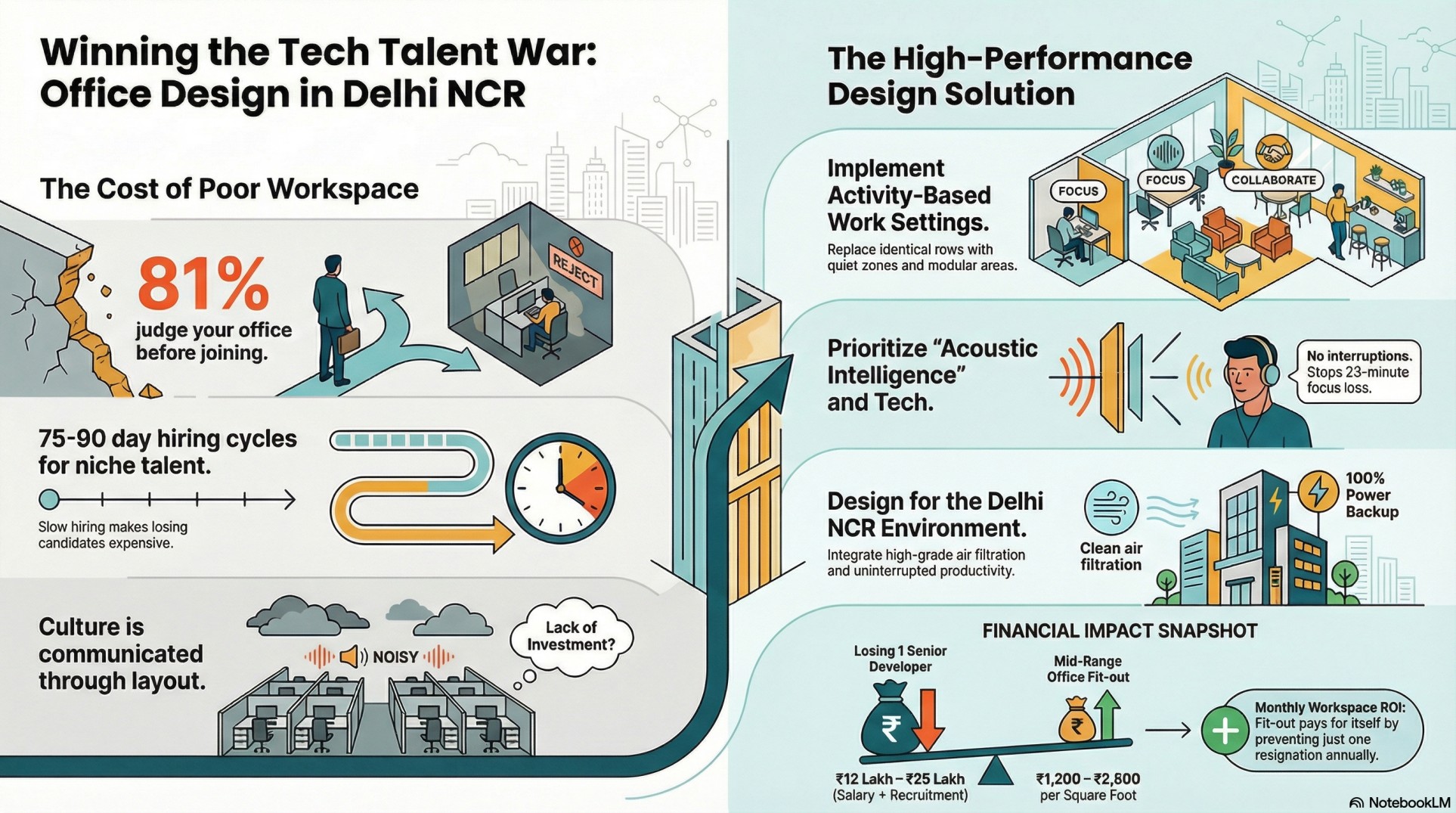
Research from the tech sector shows 81% of job seekers consider physical workspace when evaluating employers. Another study found 73% of tech professionals are motivated by working for companies with clear purpose, and your office is the physical expression of that purpose.
Delhi NCR hosts roughly 270-275 Global Capability Centres employing hundreds of thousands of tech professionals. Major companies like TCS, HCLTech, Microsoft, Oracle, IBM, Wipro, and Genpact compete for the same talent pool. When everyone offers competitive salaries and remote flexibility, the office environment becomes the differentiator.
Current hiring data shows average time-to-hire extended to 45-60 days in 2025, stretching to 75-90 days for niche skills like AI, machine learning, and cybersecurity. Companies can’t afford to lose candidates because their office looks worse than competitors’.
Think about what happens when candidates walk through your space during final interviews. They’re evaluating whether they can imagine themselves working there daily. They’re judging your culture based on layout, lighting, noise levels, furniture quality, and whether the space looks designed or just furnished.
First impressions form in seconds. An office that feels cramped, dark, noisy, or generic communicates that you don’t care about employee experience. A well-designed space communicates that you invest in your team.
The Hybrid Work Reality
Delhi NCR tech companies navigate hybrid schedules where most developers work from home 2-3 days weekly. This changes what offices need to do.
Pre-pandemic offices were designed around assigned desks supporting individual work. That model is dead for tech companies. Your team comes to office for reasons they can’t replicate at home: collaboration, connection, mentorship, focused pair programming, and culture building.
Modern tech offices need fewer individual workstations and more spaces designed for specific activities. The office becomes a hub for connection and teamwork rather than a place where everyone sits at desks typing independently.
JLL’s technology office spaces research found collaboration, culture, and social connection are the most important drivers for tech employees seeking office time. Organisations focused on tech-enabled spaces provide peak experiences that make coming to office worthwhile.
Practical implications: when your team shows up twice weekly, they expect variety in work settings, reliable video conferencing for hybrid meetings, and spaces that justify commuting time. Rows of identical desks don’t cut it anymore.
Activity-Based Work Settings
Different work requires different environments. Coding a complex feature needs quiet focus. Brainstorming product roadmaps needs open collaboration. Code reviews need comfortable seating for two people looking at same screen. Sprint planning needs team gathering space.
Activity-based design provides choices rather than forcing everyone into identical settings.
Quiet focus zones: Enclosed or semi-enclosed spaces with acoustic treatment for deep work. Individual booths, small offices, or library-style areas where interruptions are discouraged. These need proper desk height, good task lighting, and sound isolation. Developers working on complex problems need sustained concentration.
Collaboration zones: Open areas with modular furniture that teams can rearrange. Whiteboard walls or writable surfaces. Large displays for screen sharing. Seating that supports informal discussion. These spaces encourage spontaneous interaction and group problem-solving.
Meeting rooms: Various sizes from 2-person huddle spaces to 10-person conference rooms. Critical equipment includes reliable video conferencing, wireless screen sharing, good microphones and speakers, and proper lighting for camera visibility. Hybrid meetings are the norm, so technology must work flawlessly.
Social spaces: Break areas, pantries, or lounge settings where people interact informally. Comfortable seating, coffee quality that doesn’t embarrass you, and layouts encouraging conversation. These spaces build culture and facilitate the informal knowledge transfer that happens over coffee chats.
Phone booths: Small enclosed spaces for taking calls without disturbing others. Your open office plan needs enough of these that people aren’t fighting for availability.
According to Office Principles’ 2026 design trends, modern offices must serve dual purposes: supporting employees who split time between home and office whilst providing compelling reasons to come in. Teams Ready rooms equipped for smooth virtual collaboration and flexible meeting areas that adapt to varying team sizes have become standard requirements.
The key insight: workers don’t need identical desks. They need variety that matches their daily task mix.
Acoustic Design: The Silent Killer of Productivity
Open offices are popular in tech culture for good reasons: they’re flexible, facilitate collaboration, and feel democratic. They’re also noisy as hell without proper acoustic treatment.
Constant background noise from conversations, keyboards, phone calls, and meeting room discussions destroys concentration. Research shows it takes 23 minutes to regain focus after interruption. In noisy offices, interruptions happen constantly.
Delhi NCR tech offices must address acoustics during design, not afterwards when people complain.
Ceiling treatments: Acoustic panels or baffles absorb sound reflection. Open ceilings with exposed services look industrial but reflect sound terribly. Installing acoustic treatments dramatically reduces ambient noise.
Carpet or acoustic flooring: Hard surfaces reflect sound, soft surfaces absorb it. Carpet tiles provide acoustic benefit whilst allowing individual replacement. Luxury vinyl with acoustic backing works in pantries and circulation areas where spills are common.
Partition types: Glass partitions look modern but don’t block sound. Acoustic glass or solid partitions with proper sealing provide privacy. Open offices need strategic partial-height partitions creating acoustic zones without full enclosure.
White noise systems: Gentle background sound masks conversations, making open areas feel quieter. Modern systems adjust volume dynamically based on detected noise levels.
Distance and density: Space planning matters. Putting quiet focus zones far from collaboration areas reduces noise transfer. Not packing desks densely gives sound room to dissipate.
The 2026 shift toward acoustically intelligent design reflects how contemporary offices are actually used. The best modern office renovation projects balance collaboration with need for quiet, focused work, particularly as employees spend significant time on video calls requiring controlled sound environments.
Gurgaon’s Cyber City office towers and Noida’s SEZ campuses can be especially challenging acoustically because of high-density layouts and all-glass construction. Working with acoustic consultants during planning prevents expensive retrofits later.
Technology Infrastructure That Actually Works
Nothing destroys credibility faster than unreliable office technology. When developers join video calls and wi-fi drops, or wireless display sharing fails during client presentations, or conference room booking systems don’t sync, your team spends mental energy on infrastructure rather than actual work.
Tech offices need infrastructure designed by people who understand how developers work, not just standard commercial IT.
Network capacity: Gigabit ethernet to desks, enterprise-grade wi-fi with proper access point density and channel management, redundant internet connections. Your team downloads large files, streams video calls, and runs bandwidth-intensive development tools simultaneously. Plan for peak load plus growth headroom.
Power delivery: Outlets at every desk, USB charging points, cable management solutions that don’t create desk clutter. Modern work requires multiple devices: laptop, monitor, phone, tablet. Make power access effortless.
Display and video systems: Large monitors at workstations (developers need screen real estate), wireless screen sharing that works reliably, video conferencing systems with quality cameras/mics/speakers, room booking displays that sync with calendars.
Security and access: Biometric or card access, network segmentation, secure areas for sensitive work, visitor management systems. Tech companies handle proprietary code and data requiring proper security controls.
Backup systems: UPS for critical equipment, redundant network paths, emergency lighting. Power cuts in Delhi NCR aren’t rare. Your infrastructure shouldn’t go dark during outages.
Smart building integration is becoming standard. According to OP Group’s analysis, artificial intelligence has transitioned from emerging technology to fundamental element of modern offices. Space usage statistics inform design decisions, predictive maintenance addresses facility issues before they impact workers, and intelligent booking systems learn employee habits.
The test: your newest developer should join the team, walk to any desk, connect laptop, and start working within two minutes. If your technology creates friction, you’re losing productivity daily.
Natural Light and Biophilic Elements
Developers spend 8-10 hours daily looking at screens. Poor lighting creates eye strain, headaches, and fatigue. Natural light has measurable effects on mood, alertness, and wellbeing.
Delhi NCR office design should maximise natural light access whilst controlling glare on screens.
Window access: Interior layouts that don’t block windows with solid walls. Glass partitions maintaining sight lines to exterior. Workstations positioned to receive indirect natural light without screen glare.
Supplementary lighting: Task lighting at workstations, ambient lighting in circulation areas, adjustable intensity for different times of day. Avoid harsh overhead fluorescent lighting that causes eye strain.
Glare control: Window treatments or films reducing direct sun whilst allowing light transmission. South and west-facing windows in Delhi NCR get intense afternoon sun requiring proper management.
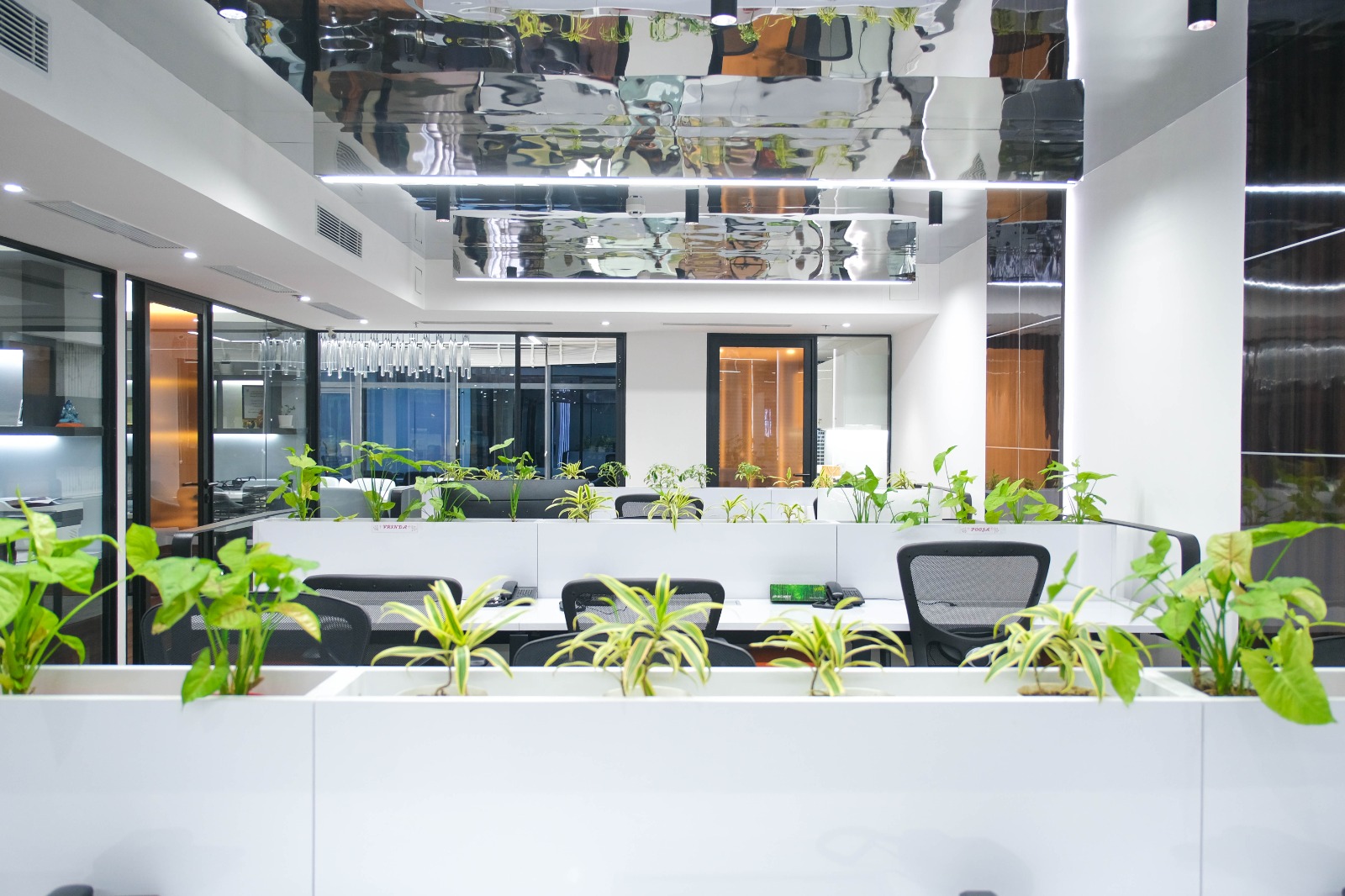
Biophilic design (incorporating natural elements) improves employee wellbeing. Research shows plants, natural materials, and nature views reduce stress and increase productivity.
Practical implementation includes indoor plants that thrive in office conditions, living walls or planted features in key areas, natural materials like wood and stone in finishes, water features providing sound and visual interest, and eco-friendly workspace design principles reducing environmental impact whilst creating healthier environments.
Gurgaon’s concrete and glass architecture often lacks green elements. Incorporating biophilic design differentiates your space whilst providing tangible wellbeing benefits.
Flexibility and Adaptability
Tech companies evolve rapidly. Team sizes change, projects shift, new technologies require different work styles. Your office should adapt without major renovations.
Modular furniture: Desks and workstations that reconfigure easily, mobile whiteboards and displays, lightweight partitions creating temporary zones, height-adjustable desks supporting sit-stand work.
Demountable partitions: Full-height walls that relocate without damaging structure. Teams can expand or contract spaces, convert open areas to enclosed rooms, or reconfigure entire floor layouts as needs change.
Infrastructure flexibility: Raised access floors or overhead cable trays allowing power/data reconfiguration, wi-fi coverage eliminating fixed desk constraints, moveable lighting fixtures adapting to layout changes.
Furniture capacity: When planning for 50 people, buy furniture for 60. Growth happens faster than furniture procurement cycles in tech companies.
JLL research found 40% of tech leaders say their portfolio will expand over next three to five years. Companies that cut too much space in 2023 are now expanding again to accommodate growth and higher office attendance. Adapting space for hybrid work and more collaboration often increases overall footprint compared with dedicated desk models.
The goal: configuration changes should take days rather than months. Your facilities team should handle most adjustments without external contractors.
Brand Expression Through Design
Your office tells your story. Tech companies often underinvest in brand expression, creating generic spaces that could belong to any company.
Strategic brand integration includes colour usage reflecting brand identity without overwhelming spaces, materials and finishes aligned with company values (a sustainability-focused company should use sustainable materials), artwork and graphics telling company story, product displays showing what you build, and cultural elements reflecting team diversity and values.
This doesn’t mean plastering logos everywhere. Subtle, thoughtful brand integration creates distinctive space that reinforces culture.
According to Interaction UK’s tech office design guide, strong office culture has direct impact on recruitment and retention. Your office isn’t just a place for employees to work; it’s where they connect with your brand.
The Social Shepherd used their iconic turquoise colour to make their space visually distinctive. That level of thoughtfulness communicates brand confidence and attention to detail.
 Delhi NCR Specific Considerations
Air quality: Delhi’s pollution requires good HVAC systems with proper filtration. Indoor air quality directly affects health and productivity. Invest in air purification systems maintaining healthy indoor environment regardless of outdoor conditions.
Temperature control: Delhi’s climate swings from winter lows requiring heating to summer peaks needing aggressive cooling. Zone-based climate control allows different areas maintaining different temperatures based on occupancy and equipment loads.
Traffic and commute: Office location affects talent access. Cyber City, Udyog Vihar, and Noida SEZ have good metro connectivity. Locations requiring long car commutes disadvantage you in talent competition. Consider office location as talent strategy, not just real estate decision.
Power reliability: Backup generators and UPS systems are non-negotiable. Your office should function during power cuts without anyone noticing.
Dust management: Delhi’s dust infiltrates buildings. Air intake filtration, proper sealing, and frequent cleaning protocols maintain clean environment.
Cost Reality and ROI
Good office design costs money. Tech companies often question ROI on workspace investment.
Consider: If better workspace design reduces time-to-hire by even one week, you’ve saved substantial opportunity cost of vacant positions. If improved environment reduces attrition by one person annually, you’ve saved recruitment costs plus productivity loss during replacement.
Delhi NCR tech salaries for skilled developers range ₹12-25 lakh annually. Losing one developer costs 6-9 months of salary in recruitment, training, and productivity loss. If your office environment contributes to even one extra departure yearly, you’ve lost more than quality workspace design would have cost.
Typical tech office fit-out costs in Delhi NCR run ₹1,200-2,500 per square foot for mid-range quality with proper technology integration, acoustic treatment, and flexibility. A 10,000-square-foot office needs ₹1.2-2.5 crore. Spread over 5-7 years (typical lease terms), that’s ₹1.7-3.6 lakh monthly.
Compare that with losing one developer annually to workspace dissatisfaction. The ROI becomes obvious.
Making It Happen
Start by understanding how your team actually works. Survey them about workspace pain points, observe which areas get used versus which sit empty, and talk to people who recently joined or left about their workspace experience.
Visit well-designed tech offices in Gurgaon and Noida. See what works in practice rather than just viewing photos. Many companies happily show office tours to potential clients or partners.
Work with designers who understand tech culture and work styles, not just generic commercial interior firms. Your designer should ask about development methodologies, meeting patterns, technology requirements, and growth plans before showing you furniture catalogues.
Plan technology infrastructure early. Running conduits and network cabling becomes exponentially more expensive after walls are built. Involve your IT team from day one.
Test before committing. Mock up proposed workstation configurations, try out chairs and desks, verify acoustic performance of proposed treatments, and validate that conference room technology works reliably.
Budget properly. Include furniture, technology infrastructure, acoustic treatments, lighting, and contingency. Cheap decisions early create expensive problems later.
Your office is your culture made physical. In Delhi NCR’s competitive tech talent market where AI engineers command premium salaries and hiring cycles stretch 75-90 days, workspace quality separates companies that attract top talent from those watching candidates accept offers elsewhere.
Building or renovating your tech office in Delhi NCR? Get in touch with Orange Offices for workspace design that helps you win the talent war.