A Gurgaon startup received three quotes for their 3,000-square-foot office. Quote one: ₹18 lakh. Quote two: ₹32 lakh. Quote three: ₹28 lakh “all inclusive.” Same space, wildly different numbers, zero explanation of what those numbers actually covered.
They picked the cheapest. Midway through execution, surprise charges started appearing. Electrical points? Extra ₹80,000. Furniture assembly and installation? Another ₹1.2 lakh. Designer site visits beyond the initial three? ₹15,000 each. Paint brand upgrades from unspecified “standard” to actual usable quality? ₹90,000 more.
Their “₹18 lakh” project finished at ₹26.4 lakh, accompanied by bitter arguments and a workspace that didn’t match what they’d approved in mockups.
That scenario plays out constantly across Delhi NCR because office design pricing remains frustratingly opaque. Companies get vague line items, unclear inclusions, and discover costs mid-project when backing out becomes expensive and disruptive.
Orange Offices provides office interior design services in Delhi NCR, and budget transparency is not optional in our proposals. Clients deserve to know exactly where money goes, what’s included, and which choices affect final costs.
So let’s break down real office design pricing for Delhi NCR projects, from design fees through execution costs to those sneaky hidden charges that ambush budgets.
Understanding Design Fee Structures
Before anyone orders materials or schedules contractors, you pay for design work. Three pricing models dominate Delhi NCR’s market.
Per square foot pricing (most common): Designers charge ₹50-500 per square foot depending on project complexity and their experience level. A 5,000-square-foot office at ₹150 per square foot means ₹7.5 lakh in design fees.
This model works well for larger projects where scope is clear. You know your space size, multiply by the rate, and get your design cost. Simple maths.
But watch the fine print. Does that per-square-foot rate include revisions? Site visits during execution? 3D visualisations? Some designers quote attractive rates then charge separately for services you assumed were included.
Fixed project fees: After understanding your requirements, designers quote a single lump sum covering all design work. A complete office design might cost ₹3 lakh, ₹8 lakh, or ₹15 lakh depending on complexity, regardless of how many hours the team spends.
Fixed fees provide budget certainty. You won’t face hourly overruns or scope creep charges. The risk shifts to designers, incentivising them to work efficiently.
The downside? You need a crystal-clear scope upfront. Major changes mid-project trigger supplementary fees because the original quote didn’t account for redesigning everything.
Percentage of total project cost: Designers charge 10-20% of your total budget. If your complete office transformation costs ₹40 lakh in execution, design fees at 15% would be ₹6 lakh.
This model aligns designer incentives with project quality. They’re motivated to specify good materials and finishes because their fee scales with project value. But it can also incentivise expensive specifications when budget-friendly alternatives would work fine.
Bespoke office interior design requiring custom elements typically commands higher design fees because of the complexity involved in detailing unique features.
Execution Costs: Where Your Money Actually Goes
Design fees represent just 10-20% of total spending. Execution is where budgets live or die.
Civil and structural work (₹200-600 per sq ft): Partitions, false ceilings, flooring, paint, doors, and windows. For a 4,000-square-foot office, civil work might cost ₹8-24 lakh depending on materials chosen.
Gypsum board partitions cost less than glass partitions. Vitrified tiles cost less than wooden flooring. Emulsion paint costs less than textured finishes. Every choice compounds.
Many Delhi NCR offices require ceiling work because standard building heights and services don’t meet workspace needs. False ceilings running ₹75-200 per square foot add ₹3-8 lakh to a 4,000-square-foot project, but they hide unsightly ductwork and wiring whilst improving acoustic design quality.
MEP systems (₹300-800 per sq ft): Mechanical, electrical, and plumbing infrastructure. HVAC systems, electrical panels and wiring, data cabling, plumbing for pantries and washrooms, fire safety equipment.
For a 4,000-square-foot office, MEP costs typically run ₹12-32 lakh. That variance depends on system sophistication. Basic split AC units cost far less than centralised VRV systems. Standard electrical work costs less than smart building automation.
MEP is where companies get stung by hidden costs. “Electrical points as per plan” sounds clear until you discover the plan showed 80 points but you actually need 140 for your equipment. Each additional point costs ₹800-1,500, and suddenly you’re spending ₹48,000-90,000 extra.
Furniture and fixtures (₹400-1,200 per sq ft): Workstations, seating, meeting tables, storage, reception desk, breakout furniture. This category typically consumes 40-50% of total budgets.
For a 50-person office needing workstations, chairs, meeting rooms, and common areas, furniture costs range from ₹16-48 lakh.
Modular workstations from reputable manufacturers like Featherlite or Godrej cost ₹12,000-25,000 per seat depending on configuration. Imported Herman Miller or Steelcase chairs run ₹40,000-80,000 each, while quality Indian alternatives cost ₹8,000-15,000.
Custom furniture extends lead times and costs, but it fits spaces perfectly and matches brand identity exactly. Ready-made modular systems ship faster and cost less but offer limited customisation.
Finishing and branding (₹150-400 per sq ft): Lighting fixtures, signage, artwork, window treatments, décor elements, branded reception features. These finishing touches transform functional spaces into distinctive environments.
Budget ₹6-16 lakh for a 4,000-square-foot office’s finishing work. Cutting corners here is tempting when budgets tighten, but finishing work creates first impressions for clients and candidates.
According to Cushman & Wakefield’s India Office Fit-out Cost Guide, premium office fit-outs in Delhi NCR’s key business hubs increasingly focus on brand identity through high-quality finishes.
The Three-Tier Pricing Reality
Delhi NCR office design breaks into three distinct price ranges.
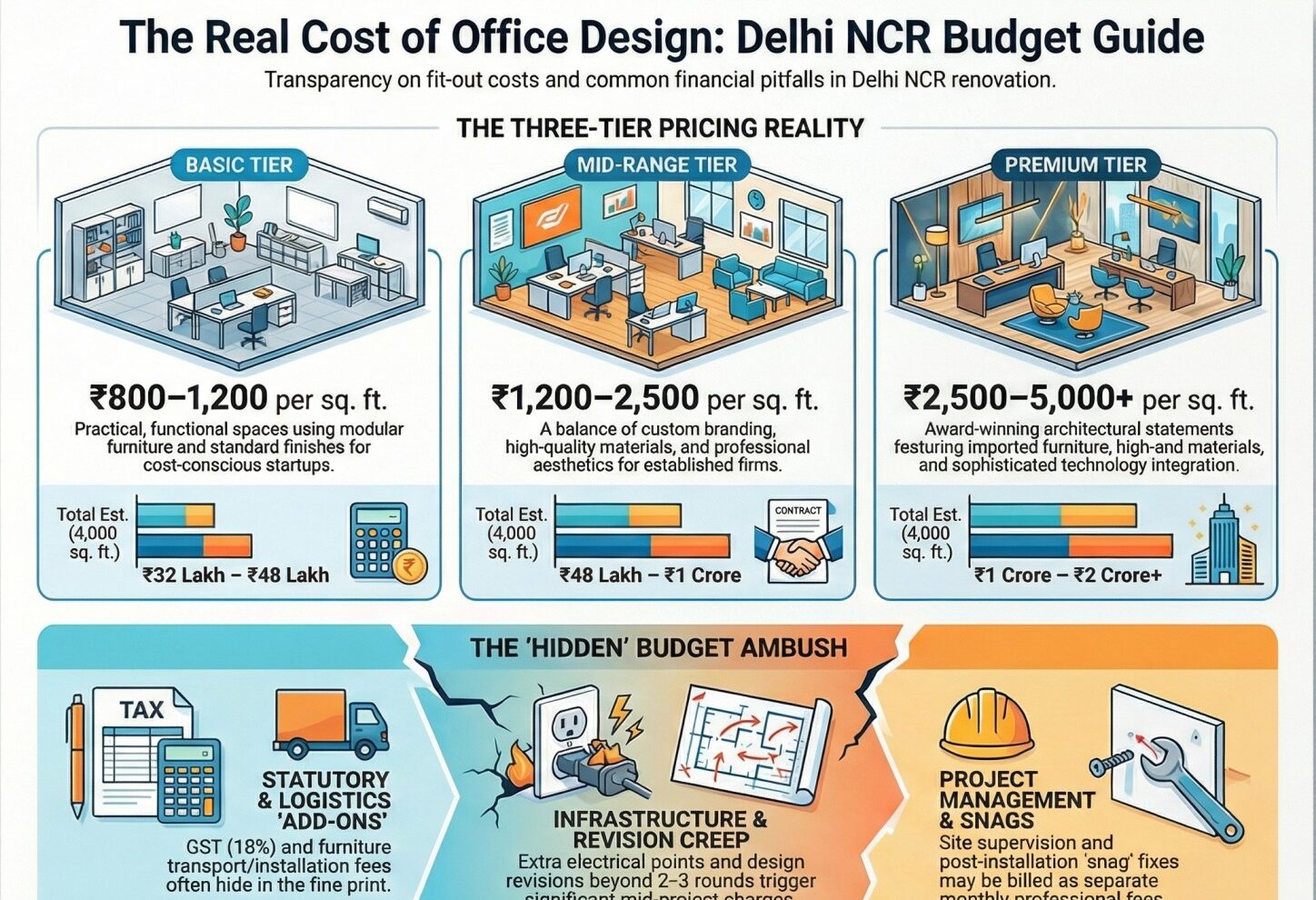
Basic tier (₹800-1,200 per sq ft total cost): Modular furniture, standard finishes, practical layouts, minimal custom work. A 4,000-square-foot office costs ₹32-48 lakh.
Basic doesn’t mean ugly or dysfunctional. It means choosing proven, budget-efficient solutions. Branded laminate workstations instead of custom millwork. Good quality fabric chairs instead of imported mesh. Vitrified tile flooring instead of wood. LED panel lights instead of designer fixtures.
This tier works perfectly for startups, cost-conscious SMEs, or companies prioritising function over aesthetics. The space works well, just without distinctive design features.
Mid-range tier (₹1,200-2,500 per sq ft total cost): Mix of modular and custom elements, better materials, thoughtful design details, branded furniture from quality manufacturers. A 4,000-square-foot office costs ₹48 lakh-₹1 crore.
This sweet spot balances quality and cost. You get some custom reception area features, better chair quality, nicer finishes, and design details that create character without breaking budgets.
Most established Delhi NCR companies targeting this range achieve professional environments that impress clients whilst controlling spending.
Premium tier (₹2,500-5,000+ per sq ft total cost): Custom everything, imported furniture, distinctive architectural features, high-end materials, sophisticated technology integration. A 4,000-square-foot office costs ₹1-2 crore or more.
Premium projects appear in design magazines and win awards. Every element is specified for aesthetics and brand expression. Modern office renovation at this level transforms ordinary spaces into architectural statements.
Companies pursuing premium design see their office as a business tool. It attracts top talent, impresses enterprise clients, and communicates success and stability.
Hidden Costs That Ambush Budgets
Transparent quotes spell out these charges. Opaque quotes bury them, then spring them mid-project.
GST (18%): Office design and execution attract 18% GST. On a ₹40 lakh project, that’s ₹7.2 lakh. Many quotes exclude GST from headline numbers, mentioning it only in fine print. Always confirm whether quotes include or exclude GST.
Transportation and installation: Furniture arrives in pieces. Someone must transport it to your office floor, unpack it, assemble it, and install it in correct positions. This labour costs ₹30,000-80,000 depending on furniture quantity and building access difficulty.
High-rise buildings without dedicated service lifts create expensive installation scenarios. Contractors must schedule after hours, use passenger lifts carefully, and work around building restrictions.
Electrical and data points beyond baseline: Design drawings show electrical and data points. But designers often underestimate actual requirements because they’re designing spaces, not specifying every device you’ll plug in.
Budget ₹50,000-1.5 lakh in contingency for additional points you’ll discover you need during installation.
Design revisions beyond agreed rounds: Most design contracts include 2-3 revision rounds. After that, changes cost money. ₹15,000-40,000 per additional revision round is common.
Limit revisions by providing clear feedback efficiently. Vague “make it more modern” feedback generates iterations that burn your revision allowance without moving forward.
Site supervision and project management: Someone must coordinate vendors, verify work quality, manage timelines, and solve problems. Some designers include this in their fees. Others charge separately at ₹40,000-80,000 per month.
Clarify this upfront. Project management saves money by preventing expensive mistakes and coordinating trades efficiently.
Post-installation snag fixing: Three months after moving in, a drawer handle breaks. Paint chips where furniture was bumped. A light fixture stops working. Who fixes these issues, and who pays?
Reputable designers include defect rectification periods (typically 3-12 months) in their contracts. During this window, they fix legitimate defects at no charge. Outside it, you’re paying for repairs.
Delhi NCR Pricing Factors
Location within Delhi NCR affects costs through labour rates, material transport, and building access.
Prime Gurgaon locations (Cyber City, Golf Course Extension Road) command 15-20% premiums over peripheral areas because vendors factor in traffic delays, restricted delivery windows, and higher building management compliance costs.
Noida typically offers 10-15% lower costs than Gurgaon’s premium corridors whilst maintaining comparable quality because of better infrastructure access and lower commercial rents affecting vendor overheads.
Monsoon timing impacts renovation costs. Projects scheduled during June-September face material delivery delays and labour shortages that can add 8-12% to budgets through inefficiencies.
Experienced designers schedule weather-sensitive work outside monsoon season or build contingencies into monsoon-period quotes.
How to Get Accurate, Transparent Quotes
Provide detailed requirements upfront: Vague briefs generate vague quotes. Specify headcount, department structure, meeting room needs, technology requirements, budget range, timeline, and quality expectations.
The more context designers receive, the better they can estimate accurately.
Request itemised breakdowns: Ask for quotes broken into categories (design fees, civil work, MEP, furniture, finishing) with per-square-foot costs and major line items visible.
Itemised quotes let you understand where money goes and where you might adjust to fit budgets.
Clarify inclusions and exclusions explicitly: Does the quote include furniture assembly? Site visits during execution? Design revisions? Post-installation support? GST?
Create a checklist and verify each item’s status. “Included, excluded, or charged separately?”
Verify material specifications: “Modular workstations” is meaningless without specifying brands, finishes, and configurations. “Paint” doesn’t indicate whether it’s Asian Paints Apcolite or budget alternatives.
Demand specification clarity. Otherwise you’ll approve quotes expecting quality materials and receive budget substitutes.
Compare like with like: Three quotes at different price points often reflect different scopes. Normalise them by confirming each includes identical work, then evaluate based on real differences.
A ₹30 lakh quote including furniture installation compared against a ₹28 lakh quote excluding installation isn’t ₹2 lakh cheaper.
Ask about payment terms: Milestone-based payments protect both parties. Typical schedules: 10-20% advance, 30-40% at material procurement, 30-40% at installation completion, 10-20% after final handover.
Never pay 100% upfront. Retaining final payments until work completion and defects are rectified gives you negotiating power if problems arise.
Check contractor credentials thoroughly: In Delhi NCR’s competitive market, fly-by-night operators offer suspiciously cheap quotes. They disappear mid-project or deliver such poor quality that fixes cost more than hiring properly initially.
Verify completed projects, speak with references, confirm financial stability and proper insurance, and check registrations exist.
Eco-friendly workspace design often requires specialised materials and certifications. Verify contractors have experience with sustainable specifications before committing.
Pricing Red Flags That Signal Problems
Certain quote characteristics suggest you’re heading for budget disasters or quality compromises.
Quotes significantly below market rates: If three quotes cluster around ₹1,800-2,200 per square foot and one comes in at ₹1,200, question why. Either scope differs dramatically, quality will be poor, or surprise charges will appear later.
Cheap isn’t cheap if it requires expensive fixes or complete redoing.
Vague line items without detail: “Interior work: ₹15 lakh” tells you nothing. What work exactly? Which materials? What quality standards? Vague quotes enable vendors to substitute cheaper alternatives claiming they meet the specification.
All-inclusive fixed prices without itemisation: “Complete office design and execution: ₹35 lakh, no hidden charges” sounds attractive but offers zero visibility into what you’re buying.
If problems arise and you want to reduce scope to fit budgets, where do you cut? Without itemisation, you can’t make informed decisions.
Unusually short timelines: Office design and execution takes time. Quotes promising a 4,000-square-foot office in 45 days when others quote 90 days suggest corners will be cut, quality will suffer, or the timeline is fantasy.
Unrealistic schedules create stress and force rushed decisions that cost money.
No clarity on design revision limits: Open-ended revision allowances sound client-friendly but incentivise designers to discourage changes with slow responses and pushback. Clear revision limits (with per-revision costs for extras) create better incentives.
Exclusion of critical items: Quotes that exclude electrical work, furniture installation, or site supervision aren’t bad per se, but if you don’t realise these aren’t included, you’re in for budget shocks.
Ask specifically about potential exclusions: “Your quote includes furniture. Does it include delivery, assembly, and installation, or just the furniture pieces themselves?”
Making Budget Decisions That Work
Office design budgets balance multiple competing pressures: quality, timeline, growth plans, cash flow, and aesthetics.
Start by defining your true priorities. Is this office primarily a talent attraction tool where design quality justifies premium spending? Or is it a functional workspace where budget efficiency matters more than distinctive features?
Neither answer is wrong, but the answer determines smart budget allocation.
Plan for your actual timeline, not your desired timeline. Rushing design and execution to save time usually costs money through premium charges, mistakes, and poor decisions.
Accept that quality work requires appropriate budgets. You can improve efficiency and find savings, but you can’t get ₹2,000-per-square-foot quality at ₹1,000-per-square-foot budgets. Physics doesn’t bend that way.
Build 15-20% contingency into your budget for changes, discoveries, and additions. Projects that run exactly to original budgets are rare. Contingency prevents panic when you need flexibility.
Consider phased approaches if budgets are tight. Execute core workspace first, add finishing and branding later. Phasing spreads costs across time whilst getting you into a functional office faster.
Understand that cheap mistakes cost more than expensive quality. Furniture that breaks in 18 months requires replacement. Poor electrical work requires ripping out and redoing. Budget-grade paint that yellows requires repainting.
Initial savings often prove expensive when full lifecycle costs account for repairs, replacements, and disruption.
The best office design budgets are realistic, transparent, and aligned with business priorities. They account for all costs upfront rather than discovering them painfully mid-project.
Planning your office design budget in Delhi NCR? Get in touch with Orange Offices for transparent pricing and detailed cost breakdowns.