Getting office space calculations wrong isn’t just inconvenient—it’s expensive. Too little space and you’re cramming desks together within months, killing productivity and pushing talent towards competitors. Too much and you’re burning cash on empty square footage that could’ve funded better hires or equipment.
Orange Offices provides office interior design services in Delhi NCR, and we’ve watched dozens of businesses make costly space planning errors. The maths seems straightforward: count employees, multiply by some number, sign lease. But that oversimplified approach ignores how work actually happens in 2026, especially in markets like Gurgaon where rental rates have climbed 12-15% year-on-year and vacancy rates have tightened considerably.
So let’s break down how to calculate space requirements properly, accounting for everything from desk configurations to collaboration zones to that inevitable “we need to hire five more people next quarter” conversation.
Understanding Office Space Per Employee: The Baseline Numbers
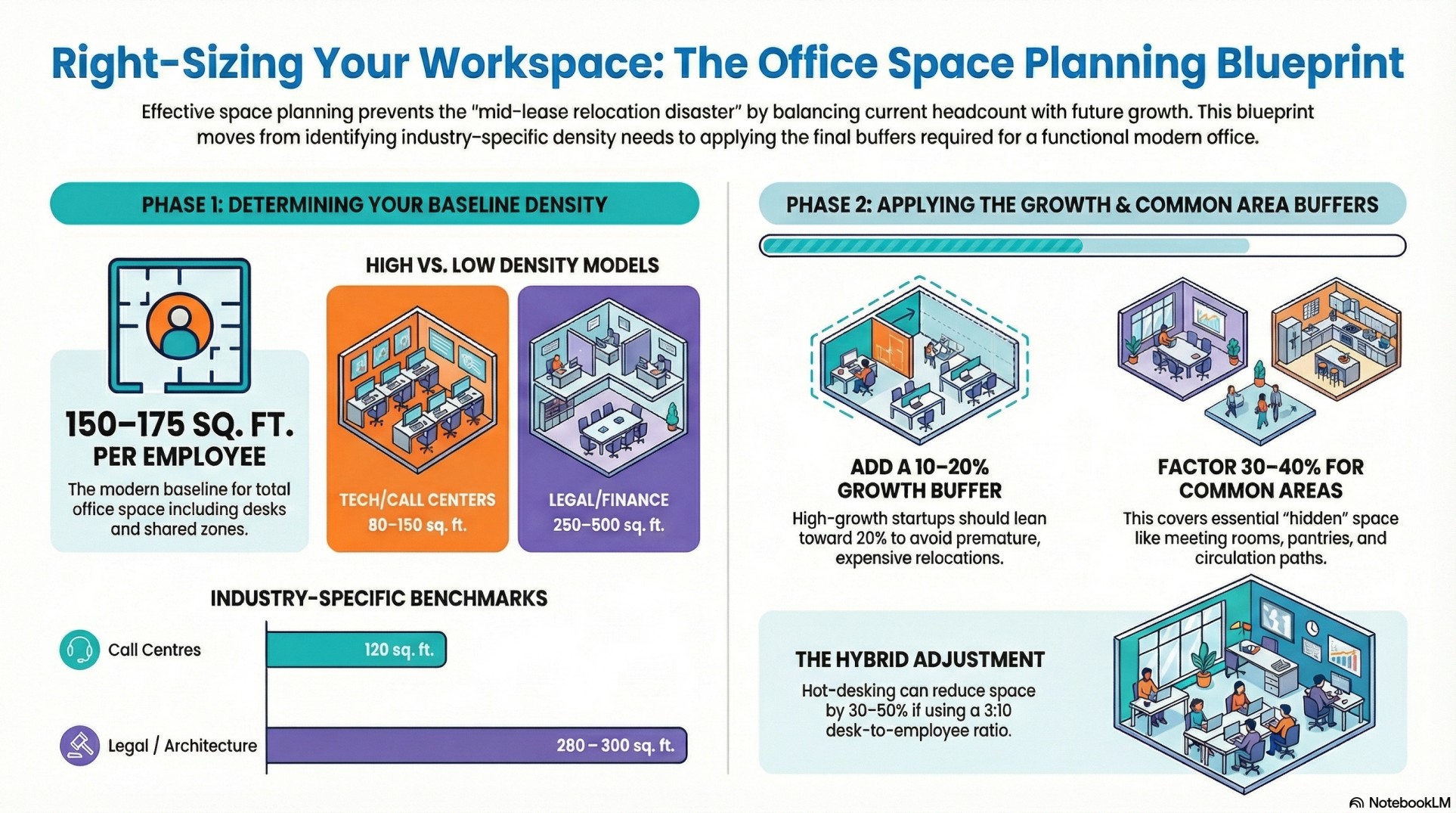
The widely cited figure you’ll see is 150-175 square feet per employee for modern offices. JLL’s 2024 Office Fit-Out Guide advises this range, and CBRE research indicates 135-225 square feet depending on workplace strategy.
But here’s what most guides won’t tell you: that square footage includes everything—not just the desk. Your employee’s 150 square feet accounts for their workstation, their proportional share of corridors, their slice of the conference room, and part of the breakout area.
Think of it like this: if you lease 10,000 square feet and plan for 60 employees at 167 square feet each, you’re not giving each person a 167-square-foot personal kingdom. You’re distributing the total space across individual workstations (60-110 square feet per person), meeting rooms, kitchen, reception, storage, and circulation paths.
Office Density: Three Common Approaches
Your industry and work culture will determine which density model fits:
High density (80-150 sq ft per employee): Open seating with minimal private offices. Common in call centres, customer support teams, and high-collaboration tech start-ups. You’ll see rows of desks, perhaps some standing workstations, and heavy reliance on shared meeting rooms. In Gurgaon locations like Udyog Vihar, many tech services companies adopt this model to maximise their ₹95-120 per square foot rental budgets.
Average density (150-250 sq ft per employee): A traditional mix of open workstations, some cubicles, and private offices for senior staff. This remains the most common configuration across industries. It balances collaborative space with focused work areas. Think about a marketing agency or mid-sized consulting firm.
Low density (250-500 sq ft per employee): Mostly private offices with generous meeting rooms. Law firms, architecture practices, and financial advisory firms typically require this layout due to confidentiality needs and client-facing work. If you’re leasing in premium areas like Golf Course Extension Road where rates reach ₹120-160 per square foot, this model demands serious budget commitment.
Industry-Specific Benchmarks
Different work requires different space:
Call centres: 120 sq ft per employee
Technology/engineering: 150-175 sq ft per employee
Marketing/creative: 175-200 sq ft per employee
Legal/architecture: 280-300 sq ft per employee
Banking/finance: 200-250 sq ft per employee
These aren’t arbitrary. Legal work involves confidential client discussions requiring enclosed offices. Tech teams need collaboration zones for sprint planning and code reviews but can work in denser configurations. Marketing teams benefit from open creative spaces but require private areas for focused campaign development.
Orange Offices has designed workspaces for all these sectors across Delhi NCR, and the patterns are consistent: companies that ignore industry norms either waste money on excess space or create dysfunctional environments that hurt performance.
The Growth Planning Problem Everyone Underestimates
Here’s where most space calculations fall apart. You measure current headcount, do the maths, sign a three-year lease, and six months later you’re hiring aggressively. Now what?
India’s office market shows unprecedented growth momentum—JLL Research reported record net absorption of 40 million square feet in January-September 2025. Global Capability Centres are expanding rapidly, often scaling teams by 30-50% annually. If you’re in tech, consulting, or business services in Delhi NCR, assuming static headcount is financial suicide.
The formula needs a growth buffer:
Base calculation + growth factor = actual space needed
For high-growth companies (tech start-ups, scaling GCCs, new market entrants): add 20% to base calculations. If you calculate 8,000 square feet for current needs, lease 9,600. This accommodates rapid hiring without triggering expensive mid-lease relocations.
For steady-state companies (established firms with predictable growth, mature market positions): add 10-15%. Your growth is slower but still real. That 10,000-square-foot office should actually be 11,000-11,500.
The Hybrid Work Adjustment
Post-pandemic attendance patterns have complicated planning. If only 60-70% of employees come to the office on any given day, can you reduce square footage proportionally?
Maybe. But it depends on whether you’re implementing hot-desking (employees book desks as needed) or maintaining assigned seating. Most Delhi NCR companies still assign dedicated desks because the cultural shift to fully flexible seating remains incomplete.
If you do embrace hot-desking, research suggests a 3:10 to 7:10 desk-to-employee ratio works. For every 10 employees, provide 3-7 desks. That could reduce space requirements by 30-50%, potentially halving your rental spend. But this requires robust booking systems, adequate lockers, and cultural buy-in—challenging in markets where traditional office norms persist.
Common Areas: The Hidden Space Consumers
Your employees need more than desks. Common areas typically consume 30-40% of total square footage. Ignore this and your supposedly adequate 10,000-square-foot office suddenly feels impossibly cramped.
What falls into common areas?
Meeting rooms: Budget 50 square feet base plus 25-30 square feet per seated person for conference-style seating. A six-person meeting room needs 200-230 square feet. For high-density offices, plan one meeting room per 10 employees. Average-density layouts need one per 20 employees. In Gurgaon’s competitive talent market, inadequate meeting space frustrates teams and signals poor planning to prospective hires.
Reception area: Allocate 100-200 square feet depending on visitor volume. This matters more than companies realise—your reception is where clients, candidates, and partners form first impressions. Bespoke office interior design includes strategic reception planning that reflects brand identity whilst managing traffic flow.
Breakout spaces and pantry: Allow 75 square feet base plus 25 square feet per person who might use it simultaneously. A 50-person office where 10 people take breaks together needs roughly 325 square feet of break area. Undersizing this creates queues at the coffee machine and reduces the restorative value of breaks.
Circulation space: Corridors, pathways between desks, waiting areas—this “wasted” space is essential for safety and comfort. Building codes and OSHA recommendations suggest maintaining at least three feet between desks and 50 square feet of usable space per employee for safe movement.
Storage: Often forgotten until boxes pile up. Allocate seven square feet per filing cabinet if you maintain paper records. Digital-first companies can reduce this, but server rooms, supply cupboards, and equipment storage still require space.
The Calculation Process: A Practical Example
Let’s work through a real scenario. You’re a 40-person marketing consultancy planning to grow to 55 people over three years. You’re based in Sector 32, Gurgaon, targeting average-density layout.
Step 1: Base calculation
Current staff: 40 people
Industry standard for marketing: 180 sq ft per employee
Base requirement: 40 × 180 = 7,200 sq ft
Step 2: Growth buffer
Expected growth to 55 people (38% increase)
Since growth is significant over three years, use 20% buffer
7,200 × 1.20 = 8,640 sq ft
Step 3: Common areas
Add 35% for meeting rooms, reception, breakout spaces
8,640 × 1.35 = 11,664 sq ft
Final requirement: approximately 11,500-12,000 square feet
At Sector 32 rates of ₹85-110 per square foot monthly, you’re looking at ₹9.75-13.2 lakh monthly rental plus CAM charges (typically ₹15-25 per square foot). Include those CAM charges in budgets—they cover lobbies, security, landscaping, and common area maintenance.
This calculation prevents the “we’ve outgrown our office in 18 months” disaster that forces expensive emergency relocations, disrupts operations, and demoralises teams.
Critical Mistakes That Sabotage Space Planning
Mistake 1: Designing without employee input
You can’t plan effective office space from a boardroom. The people who’ll use the space daily understand workflow bottlenecks, collaboration patterns, and focus requirements. Survey your team. Ask about current pain points, workspace preferences, and task requirements. Companies that skip this step often discover post-move that their beautiful new office actively hinders productivity.
Mistake 2: Ignoring acoustic design
Open layouts packed with people create noise nightmares. Research from Steelcase found that office workers lose 86 minutes daily to noise distractions. That’s 17% of an eight-hour day wasted. Proper space planning includes acoustic treatment budgets. Acoustic design considerations matter as much as square footage calculations—especially in high-density configurations.
Mistake 3: Inadequate storage planning
Clutter destroys productivity. Budget sufficient filing cabinets, shelving units, and desk organisers from the outset. Many companies calculate space perfectly but forget that everyone needs somewhere to store materials, equipment, and personal items. Three months post-move, desks overflow with papers because storage wasn’t adequately planned.
Mistake 4: Planning for peak day instead of average day
If your busiest day sees 85% office attendance but average days hover at 60%, don’t lease space for peak days. You’ll overpay constantly for occasionally-used square footage. Instead, design for 70-75% occupancy and accept that two or three peak days per year might require flexible arrangements like using meeting rooms as temporary workstations.
Mistake 5: Forgetting future technology needs
Server rooms, charging stations, AV equipment for hybrid meetings—technology requirements evolve. Leave some unallocated space or flexible zones that can adapt. Nothing dates an office faster than inadequate power outlets or cable management that assumes 2020 technology forever.
Making Space Calculations Work in Delhi NCR’s Competitive Market
Delhi NCR’s office market achieved record leasing of 15.8 million square feet in 2025 according to recent reports. Vacancy rates have tightened, rentals have climbed 6-8% year-over-year, and competition for quality space has intensified.
This environment punishes space planning mistakes harshly. There’s less flexibility to expand within buildings, fewer opportunities to renegotiate, and greater competition for every available square foot.
For businesses navigating this market, particularly in Gurgaon’s commercial corridors where rates vary from ₹65-90 per square foot on Sohna Road up to ₹140-170 in Cyber City, precise space calculations determine financial viability. Get the maths wrong and you’re either bleeding money on excess space or facing expensive emergency relocations.
The smart approach combines rigorous calculation with local market knowledge. Understanding which Gurgaon micro-markets offer expansion flexibility, which buildings have adjacent available floors, and where rental escalation clauses are negotiable matters as much as the square footage formula itself.
Modern office renovation often provides better value than relocating when you’ve underestimated space needs. Reconfiguring layouts, implementing hot-desking systems, or adding mezzanine levels can extend the life of existing leases whilst you plan strategic moves.
Beyond the Numbers: Space Planning as Strategic Tool
Office space planning isn’t just facilities management—it’s strategic business planning. Your workspace influences recruitment (candidates judge companies partly by offices), retention (people leave toxic environments regardless of pay), collaboration quality, and operational costs.
Get the calculations right and you create a foundation for growth. Employees have room to focus, teams can collaborate effectively, and you’re not panicking about capacity every time you want to hire someone.
Get them wrong and you’re fighting fires: cramming desks together, booking external meeting rooms for internal discussions, watching top performers leave for companies with better environments, and ultimately burning cash on emergency relocations.
The formula works, but only if you use it properly. Calculate current needs accurately, plan for realistic growth, include common areas generously, and leave some flexibility for the unexpected. In Delhi NCR’s dynamic market where companies scale rapidly and talent competition intensifies, this discipline separates struggling businesses from thriving ones.
Ready to translate your space calculations into a functional workspace? Get in touch with Orange Offices for your Delhi NCR office interior design requirement.